Friday, November 3, 2017

Friday, 03 Novmber, 2017

ESSENTIAL QUESTION: Why and how has the atomic theory changed over time?

LEARNING TARGET: What makes up an atom?

BENCHMARKS:  SC.8.P.8.6
LEARNING OBJECTIVES:  Students will be able to:
-Describe how phase changes in substances are affected by temperature.
-Describe the parts of an atom.

BELL RINGER: FCAT Practice: SC.8.N.1.3 The Practice of Science

Before 1896, many scientists concluded that light could not pass through black paper. In 1896, Henri Becquerel observed that uranium salts could cause a plate covered by black paper to react as if light had reached it.

How did this observation affect conclusions about light passing through black paper?

A. Scientists ignored Becquerel’s evidence because uranium is dangerous to use, so his study was not valid.

B. Scientists repeated Becquerel’s experiment until it no longer worked and reported that his conclusions were not valid.

C. Scientists had to revise their earlier conclusion because evidence from Becquerel did not support the original conclusion.

D. Scientists stood behind the earlier conclusion that black paper blocks light because it was already an accepted conclusion. 

VOCABULARY: matter, chemistry, substance, element, atom, Atomic mass, periodic table, nucleus, proton, atomic number, neutron, electron, mass number

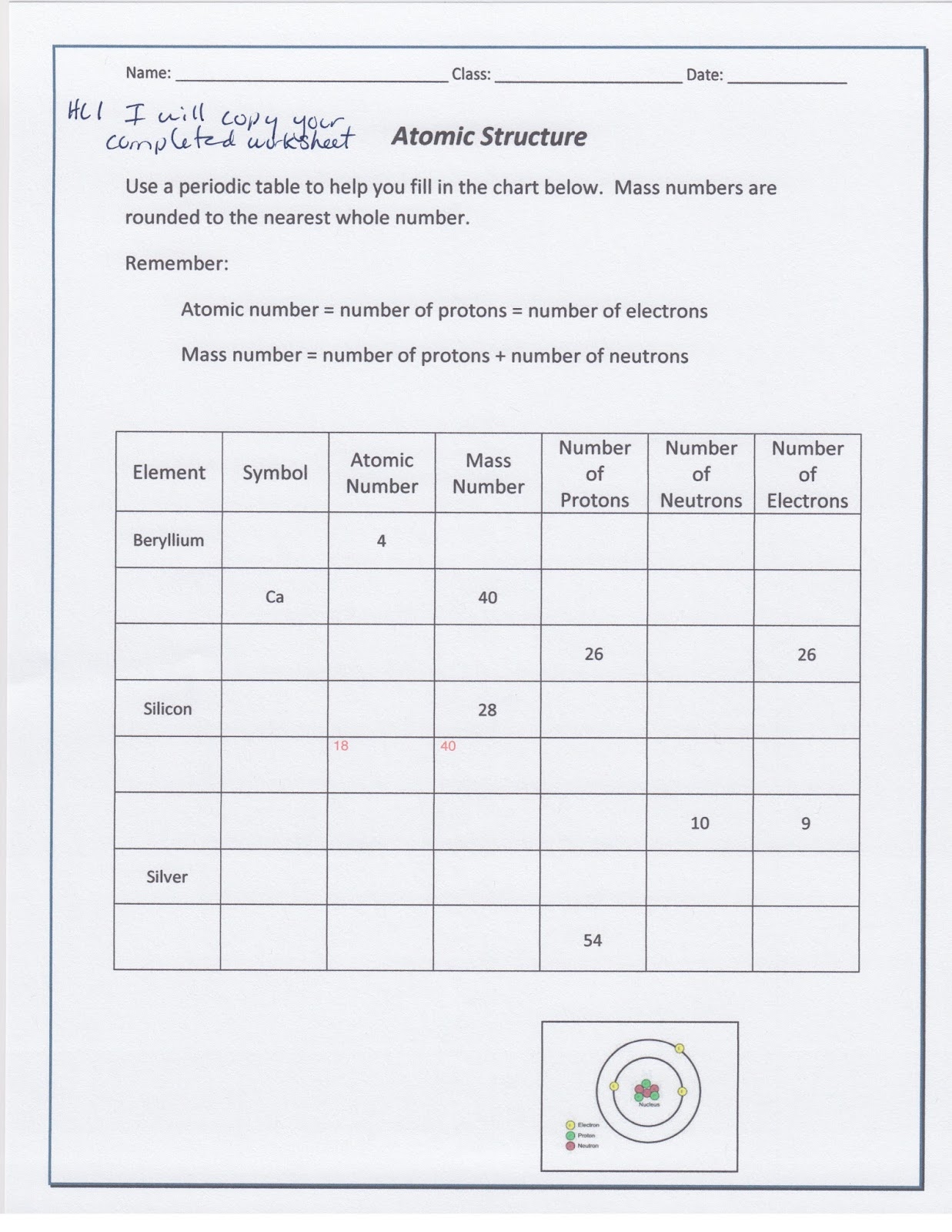
HOME LEARNING: HL 1 Atomic Structure

AGENDA
WHOLE GROUP

Students reviewed the Practice of Science by completing and discussing the bell ringer above.

Students watched a BrainPop on the Periodic Table and wrote a question from the video that other class members had to answer. You can watch the BrainPop video by visiting the site at: BrainPop Periodic Table. Once on the site, use the user name and password:
Username: amsbartow Pasword: ams13

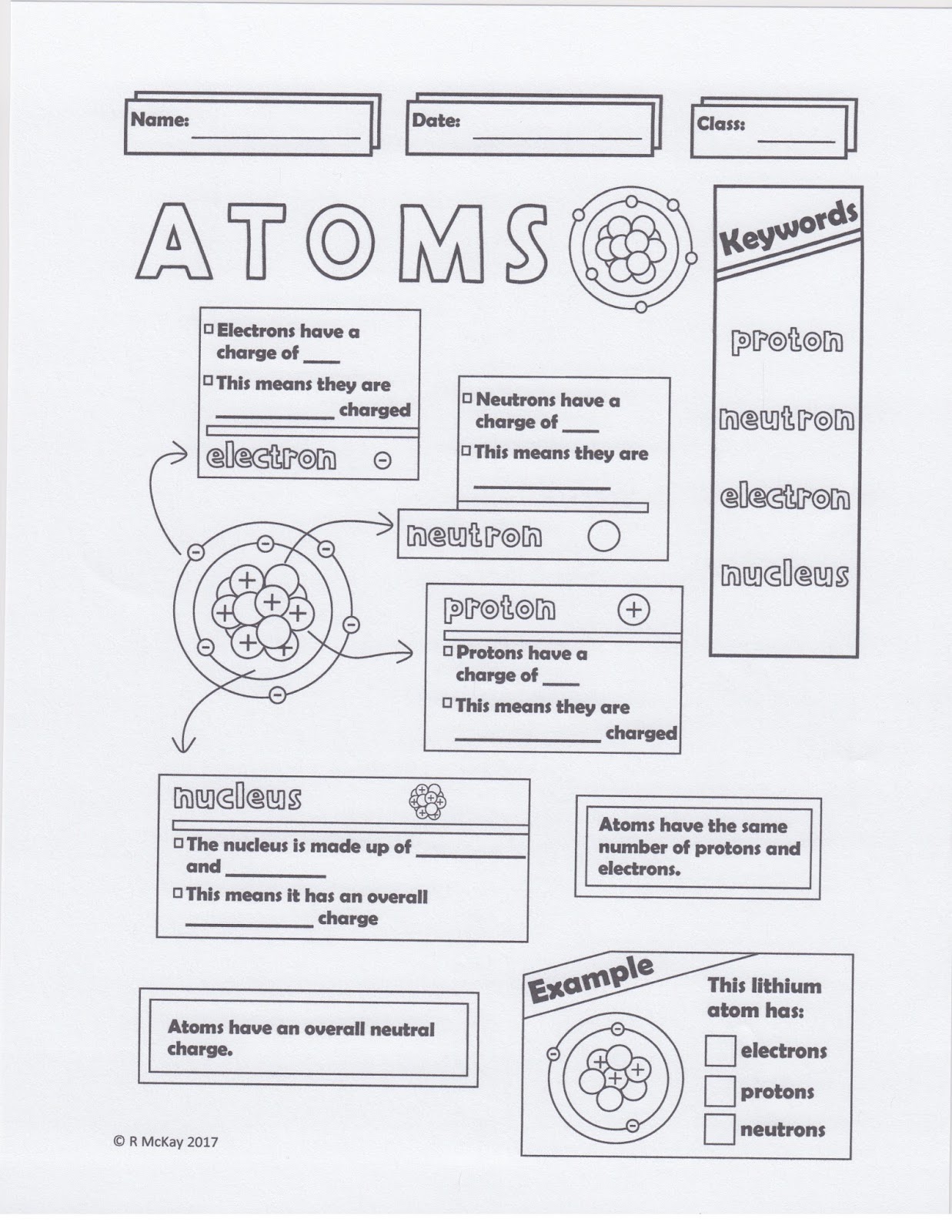
We then completed the notes/handout on atoms and their parts. You can find the handout below.
Home learning 1, which can be found above, was explained. It is due next class period.

Students also had data chats. Students had the opportunity to work on Edgenuity.

Wednesday, November 1, 2017

Wednesday, 01 November, 2017

ESSENTIAL QUESTION: Why and how has the atomic theory changed over time?

LEARNING TARGET: What makes up an atom?

BENCHMARKS: SC.8.P.8.6

LEARNING OBJECTIVES:  Students will be able to:
-Describe how phase changes in substances are affected by temperature.
-Describe the parts of an atom.
-Review quarter 1 progress.

BELL RINGER: FCAT Practice: SC.8.N.1.3 The Practice of Science

VOCABULARY: matter, chemistry, substance, element, atom, Atomic mass, periodic table, nucleus, proton, atomic number, neutron, electron, mass number

HOME LEARNING: HL 1 Atomic Structure

AGENDA
WHOLE GROUP

Students had a data chat to inform them of progress in class.

Students then went on Edgenuity to remediate lowest scores on last topic assessment.

Monday, October 30, 2017

Monday, 30 October, 2017

ESSENTIAL QUESTION: Why and how has the atomic theory changed over time?

LEARNING TARGET: Why do theories change?
BENCHMARKS:  SC.8.P.8.7

LEARNING OBJECTIVES:  Students will be able to:
-Explain why theories (such as atomic theory) may be modified but rarely discarded).
-Explain the atomic theory and how it has been modified over time. 
-Describe how phase changes in substances are affected by temperature.
-Review quarter 1 progress.

BELL RINGER: Continue Gizmo on Phase Changes

SUPPLIES/TECHNOLOGY:  white board and markers, computer(s) with internet access, LCD projector

VOCABULARY: matter, chemistry, substance, element, atom, Atomic mass, periodic table, nucleus, proton, atomic number, neutron, electron, mass number

HOME LEARNING: notebook update

RESOURCES: Mr. Spiegel will do small group DI with reading resources; Coach book, GIZMO 

AGENDA
WHOLE GROUP

Students continued to complete the Gizmo on Phase Changes

Students engaged in a data chat on progress from first grading period.

Wednesday, October 25, 2017

Wednesday, 25 October, 2017

ESSENTIAL QUESTION: Why and how has the atomic theory changed over time?

LEARNING TARGET: Why do theories change?

BENCHMARKS:  SC.8.P.8.7

LEARNING OBJECTIVES:  Students will be able to:
-Describe and illustrate the modern model of the atom and why it has changed over time.
-Explain why theories (such as atomic theory) may be modified but rarely discarded).
-Explain the atomic theory and how it has been modified over time. 
-Research information for the Infograph project on Florida Everglades

BELL RINGER: Prior knowledge questions on Gizmo Phase Changes

VOCABULARY: matter, chemistry, substance, element, atom, Atomic mass, periodic table, nucleus, proton, atomic number, neutron, electron, mass number

HOME LEARNING: notebook update
AGENDA
WHOLE GROUP

Students began with a notebook review. We spent time reviewing past concepts and topics via the interactive composition notebook. Students must be sure to include all necessary handouts and notes in each topic.

We completed activity A from the Gizmo Phase Changes.

SMALL GROUP/INDEPENDENT PRACTICE/DI

Students were given time to work on the Activity B segment of the Gizmo on their own.

Monday, October 23, 2017

Monday, 23 October, 2017

ESSENTIAL QUESTION: Why and how has the atomic theory changed over time?

LEARNING TARGET: Why do theories change?

BENCHMARKS:  SC.8.P.8.7

LEARNING OBJECTIVES:  Students will be able to:
-Describe and illustrate the modern model of the atom and why it has changed over time.
-Explain why theories (such as atomic theory) may be modified but rarely discarded).
-Explain the atomic theory and how it has been modified over time. 
-Research information for the Infograph project on Florida Everglades

BELL RINGER: Prior knowledge questions on Gizmo Phase Changes

VOCABULARY: matter, chemistry, substance, element, atom, Atomic mass, periodic table, nucleus, proton, atomic number, neutron, electron, mass number

HOME LEARNING: notebook update

AGENDA
WHOLE GROUP

Students completed the prior knowledge questions for the Gizmo Phase Changes. You can find the handout by logging into your GIZMO account and looking for the link lesson info. Then, click the student exploration sheet link.

Students completed the notes on the Atomic Theory. The video of the notes can be found in the blog for October 17.

We then worked whole class on Activity A of the Gizmo.

Home learning is to update the science notebook.

Thursday, October 19, 2017

Thursday, 19 October, 2017

ESSENTIAL QUESTION: Why and how has the atomic theory changed over time?

LEARNING TARGET: Why do theories change?

NGSSS:  SC.8.P.8.7

BENCHMARKS:
-Explore the scientific theory of atoms (also known as atomic theory) by recognizing that atoms are the smallest unit of an element and are composed of sub-atomic particles (electrons surrounding a nucleus containing protons and neutrons).

LEARNING OBJECTIVES:  Students will be able to:
-Describe and illustrate the modern model of the atom and why it has changed over time.
-Explain why theories (such as atomic theory) may be modified but rarely discarded).
-Explain the atomic theory and how it has been modified over time. 
-Research information for the Infograph project on Florida Everglades

BELL RINGER: Answer and justify. SC.8.N.3.2 The Role of Theories, Laws, Hypotheses, and Models

Scientists create both scientific theories and scientific laws as they make observations and conduct experiments about the natural world. Which of the following statements most accurately compares the difference between scientific theories and scientific laws?
A.     Scientific laws are based on evidence, while scientific theories are not.
B.     Scientific theories involve only biology, while laws involve all types of science.
C.    Scientific theories involve mathematical equations, while scientific laws are based on observations.
D.    Scientific theories are ideas that explain natural events, while scientific laws more reliably predict natural events.

VOCABULARY: matter, chemistry, substance, element, atom, Atomic mass, periodic table, nucleus, proton, atomic number, neutron, electron, mass number

HOME LEARNING: work on infograph

AGENDA
WHOLE GROUP

Students completed and shared their answers to the bell ringer.

Students then did independent work. Those that had to complete the topic 2 assessment did so and those who needed to work on their infograph did so. All infographs are due in class on Monday.

Tuesday, October 17, 2017

Tuesday, 17 October, 2017

ESSENTIAL QUESTION: Why and how has the atomic theory changed over time?

LEARNING TARGET: Why do theories change?

BENCHMARKS:  SC.8.P.8.7
LEARNING OBJECTIVES:  Students will be able to:
-Describe and illustrate the modern model of the atom and why it has changed over time.
-Explain why theories (such as atomic theory) may be modified but rarely discarded).
-Explain the atomic theory and how it has been modified over time. 
-Research information for the Infograph project on Florida Everglades
-Take the topic assessment 2 exam.

BELL RINGER: Answer and justify. 

Which order is correct, from smallest to largest?
A.  proton, element, compound, plant
B.  compound, plant, element, proton
C.  element, plant, proton, compound
D. plant, compound, element, proton

Choose the sentence below that is a correct description of a scientific theory.
A. New scientific theories are always original and do not connect to those that came before.
B. Theories in one scientific discipline do not affect theories in other disciplines.
C. Scientific theories in one discipline can influence theories in other disciplines.
D. Creativity and insight are not important parts of developing new scientific theories.

VOCABULARY: matter, chemistry, substance, element, atom, Atomic mass, periodic table, nucleus, proton, atomic number, neutron, electron, mass number

HOME LEARNING: work on infograph
AGENDA
WHOLE GROUP

Students used the bell ringer FCAT paper to record their answer and justification, before discussing with each other.

Students were given an obsertainer and asked to determine the pattern of the container without looking. They drew and then changed containers with each other. After discussing why they thought the container was configured as they drew, they had the opportunity to change their design and redraw. Once all discussions and observations were made, students opened the containers and determined the correct configuration. This lead to the discussion that theories are often changed after other scientists have the opportunity to add input to the theory or new information comes along.

We then watched a video on the history of Atoms and the Atomic Theory. You can watch the video below.
(Right now, I am having technical difficulties uploading the video). If I can, I will try to upload at a later date. You can click the link below to access the video directly:


Students began notes on Atoms and the Atomic Theory. While we did not complete the notes, we did begin. You can find the video of the power point of the entire presentation below.


Students were then given time to work on the research for their infograph project.

Friday, October 13, 2017

Friday 13 October, 2017

ESSENTIAL QUESTION: Why are physical and chemical properties useful?

LEARNING TARGET: Review for assessment

BENCHMARKS:  SC.8.P.9.2

LEARNING OBJECTIVES:  Students will be able to:
-Compare and contrast physical and chemical changes
-Explain that adding heat to or removing heat from a substance may result in a temperature change and possibly a change of state.
-Explain that mass is conserved when substances undergo physical and/or chemical changes according ot the Law of Conservation of Mass. 
-Research information for the Infograph project on Florida Everglades
-Take the topic assessment 2 exam.

BELL RINGER: Review/study session
VOCABULARY: matter, substance, solid, liquid, gas, fluid, temperature, thermal energy, heat, melting point, freezing, vaporization, evaporation, boiling, point, condensation, particle, Law of Conservation of Mass

HOME LEARNING: work on infograph
AGENDA
WHOLE GROUP

We reviewed and asked questions for the first 20 minutes of class to prepare for Topic 2 assessment.

Students then took the topic two assessment.

The remainder of the period was spent working individually on the infograph project.

Wednesday, October 11, 2017

Wednesday, 11 October, 2017

I was out of the classroom today, so students worked independently on information from the Coach book dealing with the properties of matter. The topic assessment two will be given on Friday. Home learning is to study all notes for that assessment.

Monday, October 9, 2017

Monday, 09 October, 2017

ESSENTIAL QUESTION: Why are physical and chemical properties useful?

BENCHMARKS: SC.8.P.9.2

LEARNING OBJECTIVES:  Students will be able to:
-Compare and contrast physical and chemical changes
-Explain that adding heat to or removing heat from a substance may result in a temperature change and possibly a change of state.
-Explain that mass is conserved when substances undergo physical and/or chemical changes according ot the Law of Conservation of Mass. 
-Research information for the Infograph project on Florida Everglades

BELL RINGER: Write a paragraph that explain a physical change and a chemical change you experienced in the last 24 hours. Be descriptive in your writing.

VOCABULARY: matter, substance, solid, liquid, gas, fluid, temperature, thermal energy, heat, melting point, freezing, vaporization, evaporation, boiling, point, condensation, particle, Law of Conservation of Mass

HOME LEARNING: update notebook

AGENDA
WHOLE GROUP
Students wrote a paragraph depicting a physical and a chemical change they experienced during the last 24 hours as their bell ringer.

Students then reviewed HL 6 on calculating density.

We worked in our lab notebook to begin write up of the Conservation of Mass lab. We will complete this lag at a later date.

Students needing to take the baseline exam did so, while others worked on their infograph project.

Tonight's home learning is to update the interactive notebook.