Tuesday, March 19, 2013

Tuesday/Wednesday, 19/20 March, 2013


Students will be able to:
-describe the major human body systems.
-determine how the systems work together to maintain homeostasis.

Students completed a formative assessment probe on the digestive system as their bell ringer.

Students then watched a Brain Pop video and a Discovery video on the Human Body Systems.

Students reviewed a powerpoint on Human Body systems, which you can assess via the link.


Students then participated in a ten clicker event to answer questions about the body.

Students played the Discovery Whaddaya Know Game about the Human Body.

Students completed an exit slip of FCAT type questions on the human body.

Monday, March 18, 2013

Monday/Thursday, 18/21 March, 2013


Students will be able to:
-compare and contrast the six kingdoms of living organisms.
-use the binomial classification system to name organisms.
-group organisms by characteristics.

Students completed a bell ringer on classification.

Students then watched BrainPop movies on Classification and on Six Kingdoms.

Students completed power points, with notes, on Classification and the six 
kingdoms. Click the link to view the Classification website.

Students can watch the second presentation by clicking on the video link above.

Students also completed a Glencoe virtual activity on Classification. You can find 
the activity at the link How are living things classified into groups?

Print out the table/graph and complete. Answer the journal questions.


Thursday, March 14, 2013

Thursday/Friday, 14/15 March, 2013


Add caption

Cell analogy handout for your notes.


Color and compare and contrast plant and animal cells.

Make an analogy between a school and the cell organelles.  You can also use this sheet to complete the Cell City Analogy Sheet.

Students will be able to:
-compare and contrast the structure and/or function of major organelles of plant and animal cells.

Students did the bell ringer form the powerpoint presentation, and then completed the powerpoint presentation on cells and their organelles. 

Students colored plant and animal cells in order to compare and contrast them. You can find the handout at the top of this blog.

Students also used analogies to compare the cell and its organelles to cities or schools.

Home learning 18 can be found at the top of this blog.

Wednesday, March 13, 2013

Wednesday, 13 March, 2013

This is HL 17. Letter answers only on your own paper.

Students will be able to:
-describe the patterns in the hierarchical organization of living things.
-list and describe the parts of the cell theory.

Students began class by answering questions from a powerpoint slide.


Students also received HL 17, which can be found at the top of this blog. 


Students viewed a powerpoint on organization and the cell theory. You can view the presentation by clicking the video above.

Students also worked in their groups to organize pictures using the hierarchical organization of living things.

Students also used several scenarios to identify correlations to the cell theory.

Students answered FCAT type questions for their exit slip.

Monday, March 11, 2013

Monday/Tuesday, 11/12 March, 2013

This is HL 16. Answers only on your own paper.


Students will be able to:-observe the tilt of Earth’s axis and determine why Sun rays hit locations at different angles in June and  December.-relate seasons to the duration and directness of sunlight.-compare seasons in the northern and southern hemispheres.-compare the intensity of seasonal changes at different latitudes.

Students began class with a formative probe entitled Summer Talk, where they chose a reason for earth's having seasons.


Students also received HL 16, which can be found at the top of this blog. 


Students watched a BrainPop video on Seasons.

Students viewed a powerpoint on seasons. You can view a similar animation by clicking on the link Seasons.
We also completed the GIZMO Summer and Winter. Use your username and password to sign in to your account. Search for the GIZMO, and then complete it. You can find the printed materials under the lesson materials table.

Students answered FCAT type questions for their exit slip.
Students also listened to a Bill Nye rendition on Seasons.
Finally, students reevaluated their position on seasons and determined which students from the probe 
they agreed with.

Thursday, March 7, 2013

Thursday/Friday, 7/8 March, 2013


This is HL 15. Answer both on the same sheet of loose leaf paper.

Students will be able to:
-define eclipse.
-determine how eclipses occur.
-use the positions of the Sun, Moon, and Earth to identify types of  eclipses.

Students submitted HL 14 and received HL 15, which can be found at the top of this blog.

Students watched a BrainPop movie on Eclipses. They then did the GIZMO on eclipses. 


Students then took a quiz on eclipses as their exit activity.

Wednesday, March 6, 2013

Wednesday, 6 March, 2013

This is HL 14. Answers only on your own paper.


Students will be able to:
-explain what causes tides.
-determine the effect of the Moon on tides.
-identify spring and neap tides.


Students submitted HL 13 and reviewed it, as well as received HL 14. Students
also submitted Short Story 3.  HL 14 can be found at the top of this blog.


Students watched a BrainPop video on Tides.

Students then completed a GIZMO on Tides. You can go to www.explore    
learning.com to find and complete the GIZMO at home, using your user name
and password. Search for Ocean Tides. You can also print out the student
handouts.

Students also received written notes that must be completed on tides. 

There was also a question sheet that should be answered.

All handouts, including the bell ringer probe, should be placed in the interactive
notebook.

Monday, March 4, 2013

Monday/Tuesday, 4/5 March, 2013


Students will be able to:
-explain why we see Moon phases.
-relate Moon phases to the Moon’s position.
-name the phases of the Moon in sequential order.

Students completed a probe, including a sticky note survey as their bell ringer.

Students then received HL 13, which can be found at the top of this blog.

Students watched a BrainPop movie on Moon Phases. 

Students completed a GIZMO on Phases of the Moon. You can do the GIZMO at home by signing in with your user name and password. Then, go to www.explorelearning.com and search for Moon Phases. You can get the handout by clicking on the link for lesson materials.

Students then reviewed the Moon's phases by viewing the video Phases of the Moon.

Students completed a handout where they completed the illustration of the phases of the moon.

Students then completed an exit slip and FCAT-type questions about the moon's phases.

Tuesday, February 26, 2013

Wednesday, 27 February, 2013


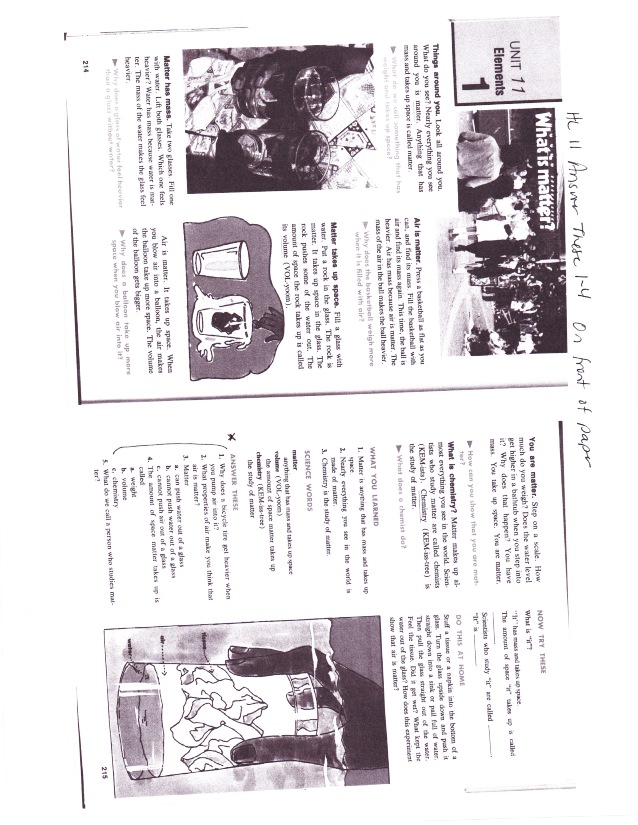
This is HL 11 and HL 12. Do both on the same sheet of loose leaf paper. Follow the printed directions.


These are the instructions for SS3.


These are the instructions for Project 3. Follow them carefully and turn your project in on time.


Students will be able to:
-review the properties of matter.
-review changes in matter.
-take a mini assessment on the EM Spectra, waves and media, and forces.


Students received HL 11 and 12, which are to be done on the same sheet of paper and can be found at the top of this blog.

Students also received the instructions for short story 3 and for project 3. Please follow all the instructions carefully and adhere to the deadline dates.

Monday/Tuesday, 25/26 February, 2013


Students will be able to:-review the properties of matter.-review changes in matter.

Students did a quick write to explain the properties of an object, which the class tried to guess.

We then practiced some FCAT type questions about matter.

Students viewed a Bill Nye video on chemical reactions.

Students then read to explain to others the handouts on matter and chemical change.

Wednesday, 27 February, 2013

Use the links below to help you find the information to successfully complete your Planet Study Project.


Planetary Fact Sheet - Metric

Data and Atmospheric Information Of Our Solar System's Planets

All Solar Planets

The Planets and Dwarf Planets

Tuesday, February 19, 2013

Tuesday, 19 February through Friday, 22 February, 2013


Answers only, both on one sheet, HL 9 on the front and HL 10 on the back. These are due in class on Thursday or Friday, depending on when your class meets.
Students will be able to:
-review the electromagnetic spectrum.
-compare and contrast the motion of different types of waves.
-determine the affect of friction of force.
-determine how heat is conducted.

Students completed a pre-assessment on waves.

Students received HL 9 and 10, which can be found at the top of this blog.

Students (Periods 1, 3, 5) will also do the reading assignment as home learning.

Students watched a demonstration of how waves travel through different media.

Students watched a video presentation on waves.

They then completed an exit slip on waves.

Students completed the mini lab on forces. 

Thursday, February 14, 2013

Thursday/Friday, 14/15 February, 2013


Students will be able to:-compare and contrast the different types of forces.-describe the effect of an unbalanced force acting on an object in terms of changes in speed, direction, and motion.

Students completed the power point on forces, including a bell ringer handout.

Students took notes on forces. The power point presentation is linked below as a movie. Take the time to review!

Students practiced determining net force.

There was no nightly home learning.


Wednesday, February 13, 2013

Wednesday, 13 February, 2013


Students will be able to:
-take an assessment on the nature of science.

Students took an assessment that reviewed the information from Monday/Tuesday on the nature of science.

There was no home learning assigned.

Monday, February 11, 2013

Monday/Tuesday, 11/12 February, 2013


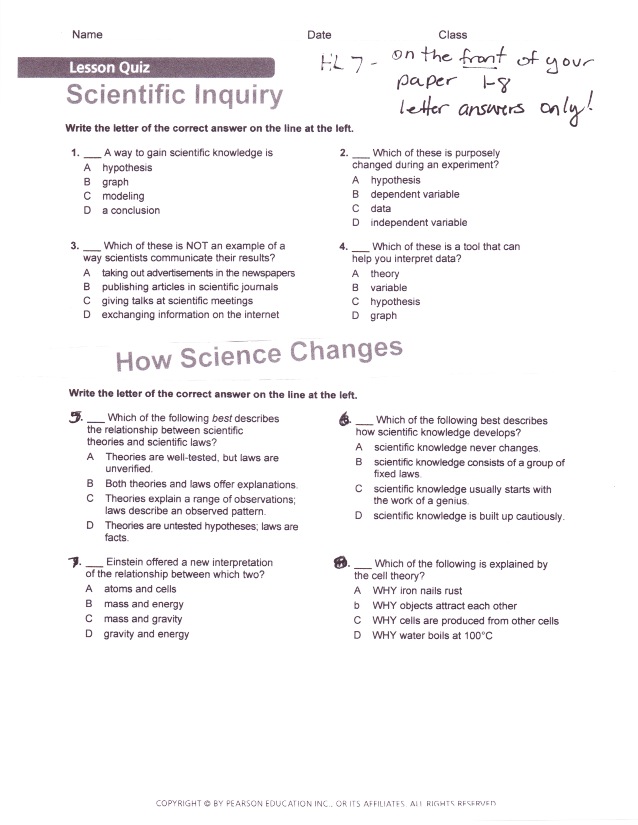
Place BOTH of these on the SAME sheet of correctly labeled loose leaf paper: HL 7 on the front and HL 8 on the back. Answers only.
Students will be able to:-describe the scientific inquiry method.-differentiate between theories and laws.

Students reviewed The Nature Of Science benchmarks from 7th and 8th grade.The do now was a SpongeBob activity about bubbles, which should be placed in the interactive notebook.


Students then completed two 
power points on The Nature of Science. I'm not sure the links will work, but you can try to see if they do!


.

Students will be able to:-describe the scientific inquiry method.-differentiate between theories and laws.

Students reviewed The Nature Of Science benchmarks from 7th and 8th grade.The do now was a SpongeBob activity about bubbles, which should be placed in the interactive notebook.

Students then completed two power points on The Nature of Science. I'm not sure the links will work, but you can try to see if they do!

Hl 7 and 8 can be found at the top of this blog.


Thursday, February 7, 2013

Thursday/Friday, 7/8 February, 2013


Students will be able to:-compare and contrast the characteristics of objects in the solar system.-identify the inner planets and their similarities.-identify the outer planets and compare them to each other and the inner planets.

Students completed any notes on the Sun. That chapter in the interactive notebook should include: the Cornell notes with the quick write on the sun, the printed notes handout, the Discovery virtual activity done Jan 29 in the computer lab on the Sun, and home learnings 3 and 4 on the sun.


Students then did notes on the solar system. That chapter in the interactive notebook should include: the Cornell notes with the quick write on the solar system, the printed notes on the solar system, the GIZMO on the solar system, and home learnings 5 and 6 on the solar system.


Be sure that for both sets of notes, you have done your three Costa;s leveled questions and your summary. Be sure you have used highlighters to correlate the questions and the answers.


Home learning is to do all of chapter 4 in your textbook, marking each page where there is a space to write.

Wednesday, February 6, 2013

Wednesday, 6 February, 2013


Students will be able to:-classify the planets as rocky planets or gas giants.-observe the scale of the solar system.-describe the shape of planetary orbits.-compare the sizes of planets.-relate the presence of an atmosphere to the size of a planet.

Students turned in Hl 5 and are remind to do HL 6. You can find it on Monday/Tuesday's blog.


Students completed a GIZMO on the solar system. This will be placed in your notebooks once we complete the Solar System notes.

Tuesday, February 5, 2013

Monday/Tuesday, 4/5 February, 2013

This is HL 5 which is due on Wednesday. Answers only. Do only 4-8.


This is HL 6, which is due on Thursday or Friday, depending on when your class meets. Answers only.


Students will be able to:-describe the physical properties of the sun.-determine how the sun produces energy.

Students completed a quick write on the Sun, which they shared with their teams.

Students viewed a BrainPop on the Sun an wrote a question to Tim and Moby on the presentation.

Students participated in an accountable talk exercise where they were given questions about the Sun and asked to explain to a partner.

Students completed notes on the Sun in their interactive notebook.

Students also participated in a data chat to find out their scores on the Winter Interim Exam.

Students also had differentiated instruction on weak benchmarks.

Home learnings 5 and 6 can be found at the top of this blog. HL 5 is due on Wednesday, and HL 6 is due on Thursday or Friday, depending on the class. Answers only.

Wednesday, January 30, 2013

Wednesday, 30 January, 2013


Students will be able to:
-describe the physical properties of the sun.
-determine how the sun produces energy.

Students received a Discovery Education handout on the Sun. They visited the following sites to complete the handout. Students must be sure to sign in with their first and last name, and to check the assignment in before exiting the site. DO NOT change the code!


Link 1 to answer the question how does the sun produce energy?

Link 2 to complete the handout.
There was no nightly home learning assigned.

Monday, January 28, 2013

Monday/Tuesday/Thursday, 28, 29, 31 January, 2013


This is HL 3. Answers only on your own paper.
This is HL 4. Answers only on the back of the same page as HL 3.

Students will be able to:
-describe the physical properties of the sun.
-determine how the sun produces energy.

Students reviewed the following questions from the mini lesson on the electromagnetic spectrum:


1. Which feature best distinguishes one form of electromagnetic energy from  another? SC.7.P.10.1
     a. color
     b. wavelength  
     c. surface temperature
     d. distance traveled


2. Denise was driving east over a hill in the afternoon, shortly after a rain shower. Suddenly the sun 
    broke through the clouds, and she saw a rainbow ahead of her. Which of the following made the 
    rainbow possible?  SC.7.P.10.1
    a. Raindrops act like a prism and separate the white light in sunlight.
    b. Water reflects sunlight like a mirror to make it look colored.
    c. Overhead black clouds reflect in puddles to cause a mirage.
    d. Air pollution causes the sky to look colored under these conditions.

Students completed the lesson on the electromagnetic spectrum by viewing a power point presentation that included definitions and a page to color the visible light spectra. Students also watched a BrainPop video on waves as part of the presentation and completed a GIZMO on the Herschel Experiment. All of these handouts should be placed in the interactive notebook.

Students then took notes, using the Cornell notes format on the sun. Students write a quick write, and collaborated on a think/write/pair/share on the sun. They then watched a BrainPop movie on the Sun. Students received handouts and took notes on the Sun. STudents completed the Costa's leveled questions and the summary for the notes, being sure to color coordinate the questions and the three leveled questions.

Home learnings 3 and 4, to be done on the SAME sheet of loose leaf paper )HL 3 on the front, HL 4 on the back), can be found at the top of this blog. These home learnings are due on Wednesday.