Thursday, April 26, 2012

Thursday and Friday, April 26 and 27, 2012


This is Short Story 4. Follow instructions and submit on time.


Students will be able to:
use the information from  videos and classroom discussions to
-analyze the structure, fuction, and regulation of the endocrine system.

Students watched a BrainPop movie on the endocrine system.

Students began notes on the endocrine system. Because this information is not in their texts, students must be present. Alternately, you can go online and find information. One such site is: Kids Health.

Students have short story 4 to complete and submit by Monday, April 30. The grading rubrics can be found at the top of this blog.

Wednesday, April 25, 2012

Wednesday, 25 April, 2012


Students will be able to:
use information from the movie The Day After Tomorrow and the series Planet Earth to
-understand humankind's role in the biosphere as it relates to Earth.

Students in the first and second period classes viewed the movie The Day After Tomorrow.

Students in later periods viewed episodes from Planet Earth to understand how humankind has changed the Earth and affected the lives of other living things on Earth.

Home learning 7 is to find a current event article from either the newspaper or online that discusses an environmental issue. The article must not be more than two weeks old. You are to summarize the article, explain the science in the article and  discuss humankind's involvement or actions in causing or participating in the event.

Tuesday, April 24, 2012

Tuesday, 24 April, 2012

Students will be able to: use information from past classes, lessons, and assignments to take the Science FCAT 2.0.

 Because of the FCAT, normal lessons are suspended. Good luck!

Monday, April 16, 2012

Monday, 16 April Through Monday, 23 April, 2012

Students will be able to:
use the information from handouts and classroom discussions to
-review for the science FCAT 2.0.

Since the Science FCAT 2.0 will be given on Tuesday, April 24, we will use all class time up to that date to review ALL past benchmarks. We will use the Saturday Success Academy document to review facts and tips for taking the science FCAT.

We will also review topics using BrainPop movies.

Your home learning is to review all notes (including 6th and 7th grade) to get ready for the exam.

Friday, April 13, 2012

Friday, 13 April, 2012

Students will be able to:
use the information from textbooks, the CPS clicker system and classroom discussions to
-review baseline exam.

Students continued reviewing the baseline exam. Using the CPS clicker system, students reviewed several questions from the exam. Students should use selective underlining and test taking skills to help find the answers prior to selecting and entering an answer with the CPS system.

Students DO NOT have to bring in texts for FCAT week. However, students SHOULD study ALL notes and handouts nightly in preparation for the Science FCAT on Tuesday, April 24.

Thursday, April 12, 2012

Thursday, 12 April, 2012

Students will be able to:
use the information from hands-on activities and classroom discussions to
-review for the science FCAT 2.0.

Students did three lab activities today to review for the science FCAT. The activities centered on reviewing earth and space science science concepts.

Students identified and matched pictures to the phases of the moon.

Students also determined how heat energy is absorbed by dark materials by measuring the change in temperature on a regular surface and a dark surface.

Finally, students identified both the internal structure of the earth and how convergent and divergent plates change the Earth's surface using a Snickers bar.

Students should study all notes, including those taken in 6th and 7th grade in preparation for the FCAT.

Wednesday, April 11, 2012

Wednesday, 11 April, 2012

Students will be able to:
use the information from hands-on activities and classroom discussions to
-review for the science FCAT 2.0.

Students did three lab activities to day to review for the science FCAT. The activities centered on reviewing physical science science concepts.

Students crushed chalk and added acid to it to observe physical and chemical changes.

Students also used slinkys to compare and contrast transverse and longitudinal waves.

Finally, students determined that the density of a fluid affects the speed of a wave by counting the waves formed in a bottle of water vs a bottle of oil.

Students should study all notes, including those taken in 6th and 7th grade in preparation for the FCAT.

Tuesday, April 10, 2012

Tuesday, 10 April, 2012

This is HL 6. Answers only on your own paper.

Students will be able to:
use the information from hands-on activities and classroom discussions to
-review for the science FCAT 2.0.

The home learning due tomorrow is HL 6. You can find it at the top of this blog.

Students did three lab activities to day to review for the science FCAT. The activities centered on reviewing life science science concepts.

Students sorted cards on the organelles found in both plant and animal cells, and matched them with their function.

Students also use comics to learn the components of the cell theory.

Finally, students reviewed variation in living things by observing the traits of several sunflower seeds and noticing the similarities and differences between them.

Monday, April 9, 2012

Monday, 9 April, 2012

This is HL 5. Answers only on your own paper.

Students will be able to:
use the information from textbooks, the CPS clicker system and classroom discussions to
-review baseline exam.

Students are responsible for HL 5, which can be found at the top of this blog.

Students continued reviewing the baseline exam. Using the CPS clicker system, students reviewed several questions from the exam. Students should use selective underlining and test taking skills to help find the answers prior to selecting and entering an answer with the CPS system.

Students DO NOT have to bring texts to class on Tuesday, Wednesday, or Thursday, due to Science Boot Camp lab activities.

Thursday, April 5, 2012

Thursday, 5 April, 2912

This is HL 4. Answers only on your own paper.

Students will be able to:
use the information from hands-on activities and classroom discussions to
-review for the science FCAT 2.0.

HL 4 is due in class on Monday. You can find it at the top of this blog.

Students did three lab activities to day to review for the science FCAT. The activities centered on reviewing earth and space science concepts.

Students viewed a photograph and determined each of the spheres of the earth and how the spheres interrelated.

Students also used a poster with many small holes, viewed up close and at a distance to demonstrate how distance makes things blurry, as does distance when viewing the stars of the Milky Way galaxy.

Finally, students used connecting cubes to demonstrate that new sedimentary rock can form during the process of weathering and compaction/cementation by connecting the blocks, breaking them apart, and reassembling them in a different arrangement.

Wednesday, April 4, 2012

Wednesday, 4 April, 2012

This is HL 3. Answers only on your own paper.

Students will be able to:
use the information from hands-on activities and classroom discussions to
-review for the science FCAT 2.0.

HL 3 is due in class tomorrow. You can find it at the top of this blog.

Students did three lab activities to day to review for the science FCAT. The activities centered on reviewing physical science concepts.

Students use a card and a rubber band to demonstrate that energy can change forms.

Students also looked at the physical properties of a pure substance, such as water.

Finally, students use spring scales to show that an object will move in the direction of the largest force exerted on it.

Tuesday, April 3, 2012

Tuesday, 3 April, 2012

This is HL 2. Answers only on your own paper.

Students will be able to:
use the information from hands-on activities and classroom discussions to
-review for the science FCAT 2.0

HL 2 is due in class tomorrow. You can find it at the top of this blog.

Students did three lab activities to day to review for the science FCAT.

Students determined that mass is conserved during a chemical change by finding the mass of objects representing molecules of a chemical reaction, such as hydrogen and oxygen in water.

Students also competed with each other to obtain "food". This activity illustrated the competition between species.

Finally, student grouped the cards from a deck of playing cards, to demonstrate that living things can be classified and grouped based on properties they have in common.

Monday, April 2, 2012

Monday, 2 April 2012

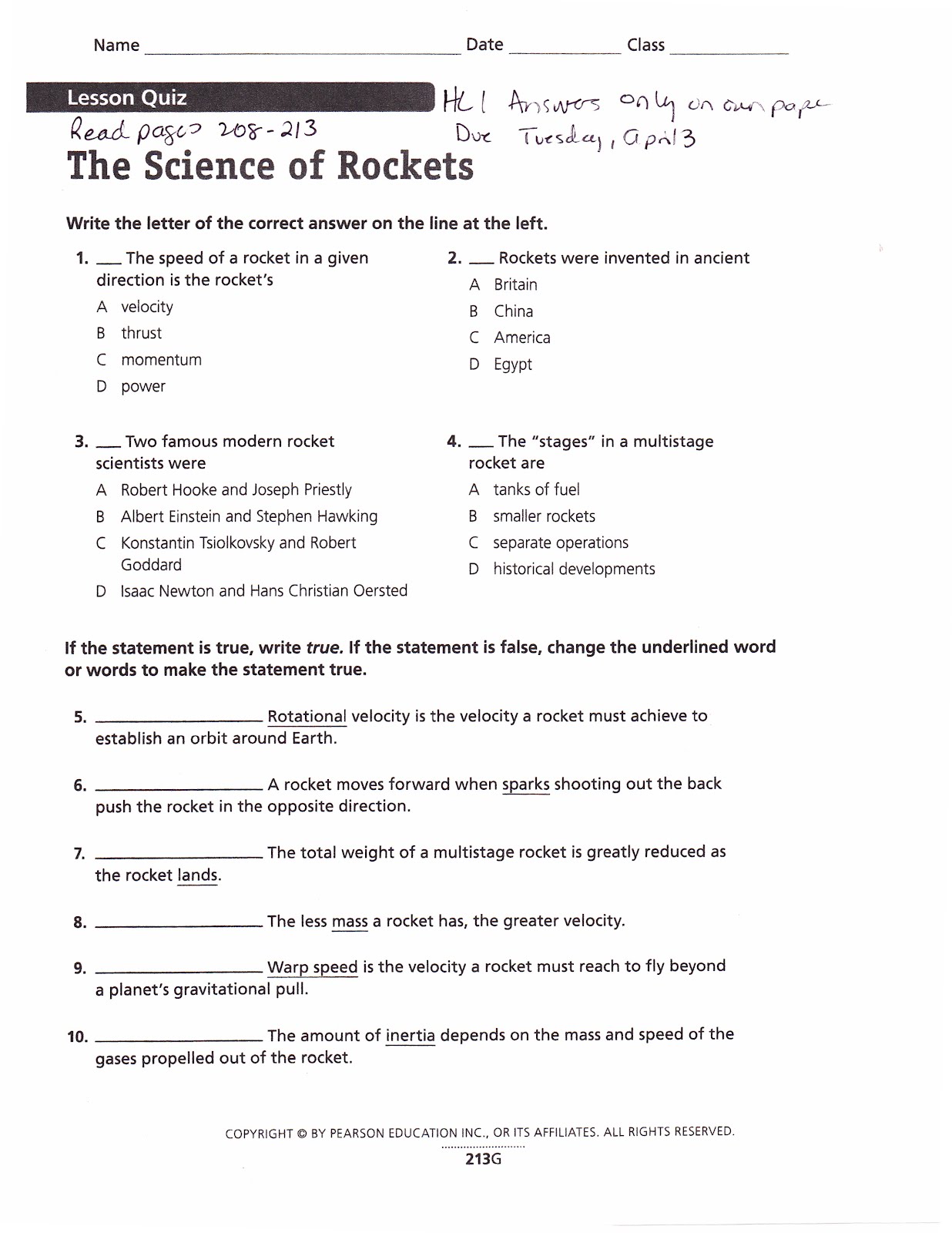
This is HL 1. Answers only on your own paper. Read the indicated pages prior to answering the questions.

Students will be able to:
use the information from textbooks, the CPS clicker system, hands-on activities, and classroom discussions to
-define eclipse.
-determine how eclipses occur.
-review genetics and inheritance using the Punnett square
-review baseline exam.

Students received HL 1, which can be found at the top of this blog.

Students completed notes from the text (p 193-194) on eclipses. They should have two column notes. Also, be sure to complete the notes with color, leveled questions, summary, and paste in HL 17 and HL 18, and the completed GIZMO on eclipses.

Students reviewed genetics by using coin tosses to construct a baby.

Students also began reviewing the baseline exam. Using the CPS clicker system, students reviewed several questions from the exam. Students should use selective underlining and test taking skills to help find the answers prior to selecting and entering an answer with the CPS system.

Thursday, March 29, 2012

Friday, 29 March, 2012

Students will be able to:
use the information from virtual activities, textbooks, hands-on activites, and classroom discussions to
-define eclipse.
-determine how eclipses occur.

Students took the remediation quiz for the seventh grade Earth/Space science benchmarks and MA 6 on the 8th grade benchmarks dealing with the Earth in time and space.

Students then took notes on eclipses. Remember to put the correct information in the table of contents:
Date 3/29 Benchmark SC.8.E.5.6 Topic Eclipses Page
Then, turn to that page and make a Cornell notes page. On the top, make sure there is a page number and a date. Include the topic. Next, draw something to remind you of solar and lunar eclipses. Use color.

On the next page, write the definition of an eclipse. Then, make a two column notes, with the following categories:
Columns: Solar and Lunar
Rows:
Row 2: Position of Celestial Bodies
Row 3: Total Eclipse Description
Row 4: Partial Eclipse Description

Don't forget to write your three leveled questions and summary on the Cornell notes page. Also, use three differently colored highlighters to correlate the questions in the margin of the Cornell notes page to the answers in the notes section.

After the notes, paste in HL 17 and 18. Also paste in the GIZMO on Eclipses. DO NOT paste it so you cannot see what was written! Place paste ONLY on the strip at the top before pasting in, so you can see BOTH sides of the GIZMO sheet. Be sure you completed the sheet prior to pasting it in your notebook.

Wednesday, March 28, 2012

Wednesday, 28 March, 2012

Students will be able to:
use the information from virtual activities, textbooks, hands-on activites, and classroom discussions to
-define eclipse.
-determine how eclipses occur.

Students performed a lab modeling both solar and lunar eclipses.

Tonight, study for the quizzes on the remediation (7th grade earth and space topics rocks, geological changes to the earth, and theories of plate tectonics.

Monday, March 26, 2012

Monday and Tuesday, 26 and 27 March, 2012

This is HL 17. Answers only on your own correctly headed paper.

This is HL 18. Answers only on your own correctly headed paper. Obviously, there should only be ONE of these pages. Follow the printed directions.

Students will be able to:
use the information from virtual activities, textbooks, hands-on activites, and classroom discussions to
-define eclipse.
-determine how eclipses occur.

Students received HL 17 and 18, which can be found at the top of this blog. HL 17 is due tomorrow. HL 18 is due on Wednesday.

Students worked on the GIZMO Eclipses. This will be placed in the interactive notebook with the week's notes.

Students received the differentiated learning activities for this week. This includes the Pearson work, found at myscienceonline.com and the work on Dr. Gayden's Science Zone (drgcdms.podomatic.com). The required assignments are listed below:

Remediation Week of 3/26/12

SC.7.E.6.2 Identify the patterns within the rock cycle and relate them to surface events (weathering and erosion) and subsurface events (plate tectonics and mountain building).

1. Do ALL Pearson assigned activities
2. Also, go to Dr Gayden’s Science Zone (drgcdms.podomatic.com) and do the activity under the first link.
3. Seventh Grade Coach book pages 54-57.

SC.7.E.6.4 Explain and give examples of how physical evidence supports scientific theories that Earth has evolved over geologic time due to natural processes.

1. Do ALL Pearson assigned activities.
2. Also, go to Dr Gayden’s Science Zone (drgcdms.podomatic.com) and do the activity under the second link.
3. Seventh Grade Coach book pages 58-62.

SC.7.E.6.5 Explore the scientific theory of plate tectonics by describing how the movement of Earth’s crustal plates causes both slow and rapid changes in Earth’s surface, including volcanic eruptions, earthquakes, and mountain building.

1. Do ALL Pearson assigned activities.
2. Also, go to Dr Gayden’s Science Zone (drgcdms.podomatic.com) and do the activity under the third link.
3. Seventh Grade Coach book pages 44-53.

The topics from Pearson online are:

Art in Motion: Changing Earth's Crust

Art in Motion: Stresses and Faults

Art in Motion: Volcanic Boundaries and Hot Spots

Key Concept Summaries What Are Mid-Ocean Ridges?

Key Concept Summaries: How Are Earthquakes Measured?

Key Concept Summaries: How Are Sedimentary Rocks Used?

Key Concept Summaries: How Can Rock Layers Change?

Key Concept Summaries: How Do Faults Form?

Key Concept Summaries: How Do Geologist Classify Rocks?

Key Concept Summaries: How Do Geologists Classify Igneous Rocks?

Key Concept Summaries: How Do Scientists Determine Earth's Age?

Key Concept Summaries: How Do Sedimentary Rocks Form?

Key Concept Summaries: How Do Seismographs Work?

Key Concept Summaries: How Does Plate Movement Create New Landforms?

Key Concept Summaries: How Has Earth Changed Over Time?

Key Concept Summaries: How Is an Epicenter Located?

Key Concept Summaries: How Old Are Rock Layers?

Key Concept Summaries: What Are Fossils?

Key Concept Summaries: What Are Metamorphic Rocks?

Key Concept Summaries: What Are Seismic Waves?

Key Concept Summaries: What Are the Kinds of Fossils?

Key Concept Summaries: What Are the Stages of Volcanic Activity?

Key Concept Summaries: What Are the Three Major Types of Sedimentary Rocks?

Key Concept Summaries: What Do Fossils Show?

Key Concept Summaries: What Happens When a Volcano Erupts?

Key Concept Summaries: What Happens at Deep-Ocean Trenches?

Key Concept Summaries: What Is Radioactive Dating?

Key Concept Summaries: What Is Sea-Floor Spreading?

Key Concept Summaries: What Is the Geologic Time Scale?

Key Concept Summaries: What Is the Rock Cycle?

Key Concept Summaries: What Landforms Does Magma Create?

Key Concept Summaries: What Landforms Do Lava and Ash Create?

Key Concept Summaries: What Patterns Do Seismographic Data Reveal?

Key Concept Summaries: What Was Wegner's Hypothesis About the Continents?

Friday, March 23, 2012

Friday, 23 March, 2012

Students will be able to:
use the information from hands-on activites and classroom discussions to
-use Punnett squares and pedigrees to determine genotypic and phenotypic probabilities.

Students watched a BrainPop movie on Tides, which we failed to watch yesterday.

Students then completed the Simpson's genetics package, learning how to complete a Punnett square and determine probabilities for genotypes and phenotypes.

Your interactive notebook is due on Monday. It should include:

Date-Benchmark---Topic--------------Home Learnings--GIZMO handout
3/1--SC.8.E.5.9---Phases of the Moon-HL 12-----------GIZMO Phases of the Moon
3/8--SC.8.E.5.9---Seasons------------HL 13 and HL 14-GIZMO Seasons
3/22-SC.8.E.5.9---Tides--------------HL 15 and HL 16-GIZMO Tides

Thursday, March 22, 2012

Thursday, 22 March, 2012

Students will be able to:
use the information from virtual activities, textbooks, hands-on activites, and classroom discussions to
-describe the effects of the moon and sun on tides.
-identify and explain spring and neap tides.

Students took notes from the 8th grade text, pages 197-199.

Students should be sure to:
write the date, benchmark, topic and page number in their table of contents, which should be
3/22 SC.912.E.5.6 Tides

On the Cornell Notes page, be sure to draw something to remind you about tides. You can get this either from the text, the GIZMO on tides, the home learning, or something you've experienced or seen. Also, write the three leveled questions and the summary. Possible questions:
1. What is a tide?
2. Compare the causes of high and low tides.
3. Predict which type of tide (neap or spring) will occur for the month of April on the dates April 7, April 1, April 13, and April 29.

Be sure to use three different colored highlighters to connect the questions and the answers found in your notes.

Your summary should include the definition of tides and how the sun and the moon influence Earth's waters.

Behind these notes, paste in home learnings 15 and 16. Also, paste in the COMPLETED GIZMO on Tides.

Notebook check is on Monday.

Wednesday, March 21, 2012

Wednesday, 21 March, 2012

This is HL 16. Answers only on your own paper. Follow directions!

Students will be able to:
use the information from virtual activities, textbooks, hans-on activites, and classroom discussions to
-describe the effects of the moon and sun on tides.
-identify and explain spring and neap tides.

Students completed a lab on how to determine the times for high tides at two locations. Students also learned about the position of cities on the coast and how this affects their high and low tide times.

Students also reviewed genetics and Punnett squares.

Home learning 16, which can be found at the top of this blog, is due tomorrow.

Monday, March 19, 2012

Monday and Tuesday, 19 and 20 March, 2012

This is HL 15. It is due on Wednesday. Answers only on your own correctly headed paper.
This is HL 16. It is due on Thursday. Answers only on your own correctly headed paper.

Students will be able to:
use the information from virtual activities, textbooks, hans-on activites, and classroom discussions to
-describe the effects of the moon and sun on tides.
-identify and explain spring and neap tides.

Students received HL 15 and 16, which can be found at the top of this blog. HL 15 is due on Wednesday. HL 16 is due on Thursday.

Students also received their remediation plan for this week. It can be found located at the bottom of this blog.

Students worked on the GIZMO Tides in class. The completed GIZMO will be placed in the notebook with this week's notes.

Remediation Week of 3/19/12

SC.7.L.15.2 Explore the scientific theory of evolution by recognizing and explaining ways in which genetic variation and environmental factors contribute to evolution by natural selection and diversity of organisms.

1. Do ALL Pearson assigned activities
2. Also, go to Dr Gayden’s Science Zone (drgcdms.podomatic.com). There are two activities that deal with this topic. Do both. Use the handout provided to do the Explore Learning activity.
3. Seventh Grade Coach book pages 100-103.

SC.7.L.15.3 Explore the scientific theory of evolution by relating how the inability of a species to adapt within a changing environment may contribute to the extinction of that species.

1. Do ALL Pearson assigned activities.
2. Also, go to Dr Gayden’s Science Zone (drgcdms.podomatic.com). Click the link to learn more about the topic.

SC.7.L.16.1 Understand and explain that every organism requires a set of instructions that specifies its traits, that this hereditary information (DNA) contains genes located in the chromosomes of each cell, and that heredity is the passage of these instructions from one generation to another.

1. Do ALL Pearson assigned activities.
2. Also, go to Dr Gayden’s Science Zone (drgcdms.podomatic.com). Click the link to learn more about the topic.
3. Seventh Grade Coach book pages 104-107.

SC.7.L.17.2 Compare and contrast the relationships among organisms such as mutualism, predation, parasitism, competition, and commensalism.

Pearson Remediations include:

Art in Motion: Understanding DNA
Key Concept Summaries:How Do New Species Form?
Key Concept Summaries: How Are Chromosomes, Gene, and Inheritance Related?
Key Concept Summaries: How Do Adaptations Help an Organism Survive?
Key Concept Summaries: How Do Alleles Affect Inheritance?
Key Concept Summaries: How Does DNA Copy Itself?
Key Concept Summaries: How Is an Ecosystem Organized?
Key Concept Summaries: What Are Competition and Predation?
Key Concept Summaries: What Are Some Patterns of Human Inheritance?
Key Concept Summaries: What Are the Three Types of Symbiosis?
Key Concept Summaries: What Are the Two Parts of an Organism’s Habitat?
Key Concept Summaries: What Did Mendel Observe?
Key Concept Summaries: What Does an Organism Get From Its Environment?
Key Concept Summaries: What Factors Affect Biodiversity?
Key Concept Summaries: What Is Natural Selection?
Key Concept Summaries: What Was Darwin's Hypothesis?
Key Concept Summaries: Why Do Species Go Extinct?