Monday, March 26, 2012

Monday and Tuesday, 26 and 27 March, 2012

This is HL 17. Answers only on your own correctly headed paper.

This is HL 18. Answers only on your own correctly headed paper. Obviously, there should only be ONE of these pages. Follow the printed directions.

Students will be able to:
use the information from virtual activities, textbooks, hands-on activites, and classroom discussions to
-define eclipse.
-determine how eclipses occur.

Students received HL 17 and 18, which can be found at the top of this blog. HL 17 is due tomorrow. HL 18 is due on Wednesday.

Students worked on the GIZMO Eclipses. This will be placed in the interactive notebook with the week's notes.

Students received the differentiated learning activities for this week. This includes the Pearson work, found at myscienceonline.com and the work on Dr. Gayden's Science Zone (drgcdms.podomatic.com). The required assignments are listed below:

Remediation Week of 3/26/12

SC.7.E.6.2 Identify the patterns within the rock cycle and relate them to surface events (weathering and erosion) and subsurface events (plate tectonics and mountain building).

1. Do ALL Pearson assigned activities
2. Also, go to Dr Gayden’s Science Zone (drgcdms.podomatic.com) and do the activity under the first link.
3. Seventh Grade Coach book pages 54-57.

SC.7.E.6.4 Explain and give examples of how physical evidence supports scientific theories that Earth has evolved over geologic time due to natural processes.

1. Do ALL Pearson assigned activities.
2. Also, go to Dr Gayden’s Science Zone (drgcdms.podomatic.com) and do the activity under the second link.
3. Seventh Grade Coach book pages 58-62.

SC.7.E.6.5 Explore the scientific theory of plate tectonics by describing how the movement of Earth’s crustal plates causes both slow and rapid changes in Earth’s surface, including volcanic eruptions, earthquakes, and mountain building.

1. Do ALL Pearson assigned activities.
2. Also, go to Dr Gayden’s Science Zone (drgcdms.podomatic.com) and do the activity under the third link.
3. Seventh Grade Coach book pages 44-53.

The topics from Pearson online are:

Art in Motion: Changing Earth's Crust

Art in Motion: Stresses and Faults

Art in Motion: Volcanic Boundaries and Hot Spots

Key Concept Summaries What Are Mid-Ocean Ridges?

Key Concept Summaries: How Are Earthquakes Measured?

Key Concept Summaries: How Are Sedimentary Rocks Used?

Key Concept Summaries: How Can Rock Layers Change?

Key Concept Summaries: How Do Faults Form?

Key Concept Summaries: How Do Geologist Classify Rocks?

Key Concept Summaries: How Do Geologists Classify Igneous Rocks?

Key Concept Summaries: How Do Scientists Determine Earth's Age?

Key Concept Summaries: How Do Sedimentary Rocks Form?

Key Concept Summaries: How Do Seismographs Work?

Key Concept Summaries: How Does Plate Movement Create New Landforms?

Key Concept Summaries: How Has Earth Changed Over Time?

Key Concept Summaries: How Is an Epicenter Located?

Key Concept Summaries: How Old Are Rock Layers?

Key Concept Summaries: What Are Fossils?

Key Concept Summaries: What Are Metamorphic Rocks?

Key Concept Summaries: What Are Seismic Waves?

Key Concept Summaries: What Are the Kinds of Fossils?

Key Concept Summaries: What Are the Stages of Volcanic Activity?

Key Concept Summaries: What Are the Three Major Types of Sedimentary Rocks?

Key Concept Summaries: What Do Fossils Show?

Key Concept Summaries: What Happens When a Volcano Erupts?

Key Concept Summaries: What Happens at Deep-Ocean Trenches?

Key Concept Summaries: What Is Radioactive Dating?

Key Concept Summaries: What Is Sea-Floor Spreading?

Key Concept Summaries: What Is the Geologic Time Scale?

Key Concept Summaries: What Is the Rock Cycle?

Key Concept Summaries: What Landforms Does Magma Create?

Key Concept Summaries: What Landforms Do Lava and Ash Create?

Key Concept Summaries: What Patterns Do Seismographic Data Reveal?

Key Concept Summaries: What Was Wegner's Hypothesis About the Continents?

Friday, March 23, 2012

Friday, 23 March, 2012

Students will be able to:
use the information from hands-on activites and classroom discussions to
-use Punnett squares and pedigrees to determine genotypic and phenotypic probabilities.

Students watched a BrainPop movie on Tides, which we failed to watch yesterday.

Students then completed the Simpson's genetics package, learning how to complete a Punnett square and determine probabilities for genotypes and phenotypes.

Your interactive notebook is due on Monday. It should include:

Date-Benchmark---Topic--------------Home Learnings--GIZMO handout
3/1--SC.8.E.5.9---Phases of the Moon-HL 12-----------GIZMO Phases of the Moon
3/8--SC.8.E.5.9---Seasons------------HL 13 and HL 14-GIZMO Seasons
3/22-SC.8.E.5.9---Tides--------------HL 15 and HL 16-GIZMO Tides

Thursday, March 22, 2012

Thursday, 22 March, 2012

Students will be able to:
use the information from virtual activities, textbooks, hands-on activites, and classroom discussions to
-describe the effects of the moon and sun on tides.
-identify and explain spring and neap tides.

Students took notes from the 8th grade text, pages 197-199.

Students should be sure to:
write the date, benchmark, topic and page number in their table of contents, which should be
3/22 SC.912.E.5.6 Tides

On the Cornell Notes page, be sure to draw something to remind you about tides. You can get this either from the text, the GIZMO on tides, the home learning, or something you've experienced or seen. Also, write the three leveled questions and the summary. Possible questions:
1. What is a tide?
2. Compare the causes of high and low tides.
3. Predict which type of tide (neap or spring) will occur for the month of April on the dates April 7, April 1, April 13, and April 29.

Be sure to use three different colored highlighters to connect the questions and the answers found in your notes.

Your summary should include the definition of tides and how the sun and the moon influence Earth's waters.

Behind these notes, paste in home learnings 15 and 16. Also, paste in the COMPLETED GIZMO on Tides.

Notebook check is on Monday.

Wednesday, March 21, 2012

Wednesday, 21 March, 2012

This is HL 16. Answers only on your own paper. Follow directions!

Students will be able to:
use the information from virtual activities, textbooks, hans-on activites, and classroom discussions to
-describe the effects of the moon and sun on tides.
-identify and explain spring and neap tides.

Students completed a lab on how to determine the times for high tides at two locations. Students also learned about the position of cities on the coast and how this affects their high and low tide times.

Students also reviewed genetics and Punnett squares.

Home learning 16, which can be found at the top of this blog, is due tomorrow.

Monday, March 19, 2012

Monday and Tuesday, 19 and 20 March, 2012

This is HL 15. It is due on Wednesday. Answers only on your own correctly headed paper.
This is HL 16. It is due on Thursday. Answers only on your own correctly headed paper.

Students will be able to:
use the information from virtual activities, textbooks, hans-on activites, and classroom discussions to
-describe the effects of the moon and sun on tides.
-identify and explain spring and neap tides.

Students received HL 15 and 16, which can be found at the top of this blog. HL 15 is due on Wednesday. HL 16 is due on Thursday.

Students also received their remediation plan for this week. It can be found located at the bottom of this blog.

Students worked on the GIZMO Tides in class. The completed GIZMO will be placed in the notebook with this week's notes.

Remediation Week of 3/19/12

SC.7.L.15.2 Explore the scientific theory of evolution by recognizing and explaining ways in which genetic variation and environmental factors contribute to evolution by natural selection and diversity of organisms.

1. Do ALL Pearson assigned activities
2. Also, go to Dr Gayden’s Science Zone (drgcdms.podomatic.com). There are two activities that deal with this topic. Do both. Use the handout provided to do the Explore Learning activity.
3. Seventh Grade Coach book pages 100-103.

SC.7.L.15.3 Explore the scientific theory of evolution by relating how the inability of a species to adapt within a changing environment may contribute to the extinction of that species.

1. Do ALL Pearson assigned activities.
2. Also, go to Dr Gayden’s Science Zone (drgcdms.podomatic.com). Click the link to learn more about the topic.

SC.7.L.16.1 Understand and explain that every organism requires a set of instructions that specifies its traits, that this hereditary information (DNA) contains genes located in the chromosomes of each cell, and that heredity is the passage of these instructions from one generation to another.

1. Do ALL Pearson assigned activities.
2. Also, go to Dr Gayden’s Science Zone (drgcdms.podomatic.com). Click the link to learn more about the topic.
3. Seventh Grade Coach book pages 104-107.

SC.7.L.17.2 Compare and contrast the relationships among organisms such as mutualism, predation, parasitism, competition, and commensalism.

Pearson Remediations include:

Art in Motion: Understanding DNA
Key Concept Summaries:How Do New Species Form?
Key Concept Summaries: How Are Chromosomes, Gene, and Inheritance Related?
Key Concept Summaries: How Do Adaptations Help an Organism Survive?
Key Concept Summaries: How Do Alleles Affect Inheritance?
Key Concept Summaries: How Does DNA Copy Itself?
Key Concept Summaries: How Is an Ecosystem Organized?
Key Concept Summaries: What Are Competition and Predation?
Key Concept Summaries: What Are Some Patterns of Human Inheritance?
Key Concept Summaries: What Are the Three Types of Symbiosis?
Key Concept Summaries: What Are the Two Parts of an Organism’s Habitat?
Key Concept Summaries: What Did Mendel Observe?
Key Concept Summaries: What Does an Organism Get From Its Environment?
Key Concept Summaries: What Factors Affect Biodiversity?
Key Concept Summaries: What Is Natural Selection?
Key Concept Summaries: What Was Darwin's Hypothesis?
Key Concept Summaries: Why Do Species Go Extinct?

Friday, March 9, 2012

Friday, 9 March, 2012

Students will be able to:
use the information from handouts, textbooks and classroom discussions to
-compare and contrast the relationships among living things.
-understand how living things pass traits from one generation to the next.

Students worked in the Crunch time packets on symbiotic relationships.

Students also worked in the packets to learn about how living things pass traits from one generation to the next.

There are no specific homework instructions for the break, but it would be wise to go to Pearson Online and do as many of the assigned activities as possible. Also, do the assigned GIZMOs. The assessment questions at the end will serve to let me know you have completed the work.

Thursday, March 8, 2012

Thursday, 8 March, 2012

Students will be able to:
use the information from virtual activities, textbooks, hans-on activites, and classroom discussions to
-learn what causes seasons.
-relate seasons to the duration and directness of sunlight.

Students took a quiz on this week's remediation for 7th grade physical science benchmarks: SC.7.P.10.1; SC.7.P.10.3; SC.7.P.11.2; and SC.7.P.11.4.

Students watched a BrainPop movie on Seasons.

Students then took notes on pages 186-188 of their 8th grade texts. Be sure to place the following in your table of contents:
Date-3/8
Benchmark-SC.912.R.5.6
Topic-Seasons

Be sure to make a Cornell notes page that has the date, page number (be sure to include the page number in your table of contents), and topic. Draw something to remind you or represent what you've learned about the seasons. Don't forget that once you complete the notes, you must make up a level one, two and three question to accompany the notes. Also, complete the summary on the bottom of the page that summaries your notes on seasons.

A good level one question could be: What are seasons?
Level two: Compare and contrast the earth's position and the weather during summer and winter for the Northern Hemisphere.
Level three: How would the seasons be different if Earth were not tilted on its axis?

Be sure to use highlighters (three) to highlight the question and its answer in the same color.

Your notes should include:
-the names of the seasons
-how sunlight hits earth
-the earth's tilt angle
-earth's tilted axis and what happens because of it
-the definition of solstice and the dates
-the definition of equinox and the dates

Remember, your planet project is due in class tomorrow!
-how each hemisphere differs in temperature and amount of sunlight during the summer and winter because of the tilt of the earth

Wednesday, March 7, 2012

Wednesday, 7 March, 2012

Students will be able to:
use the information from virtual activities, textbooks, hands-on activites, and classroom discussions to
-learn what causes seasons.
-relate seasons to the duration and directness of sunlight.

Students did the lab Reasons for the Seasons to explore why we have seasons.

Those of you that were absent can go to the link below (cut and paste it into your browser window) and do the activity. Be sure to click the exercises tab to answer the questions. Write up the experience using your lab write-up procedures and turn it in. This can serve as the missed lab.
Link for the virtual lab:
http://highered.mcgraw-hill.com/sites/007299181x/student_view0/chapter2/seasons_interactive.html

The lab handout is to be completed and turned in tomorrow.

Monday, March 5, 2012

Monday and Tuesday, 5 and 6 March, 2012

This is HL 13. Answers only on your own paper.

Students will be able to:
use the information from virtual activities, textbooks, hans-on activites, and classroom discussions to
-learn what causes seasons.
-relate seasons to the duration and directness of sunlight.

Students received HL 13, which is due tomorrow. Be sure to head your paper correctly and place answers only on your paper, Keep the handout to check your work. This can be found at the top of this blog.

Students received the GIZMO handout on Summer and Winter, which deals with the seasons and their cause. Keep this to place in your notebook for this week.

Students began remediation work for the seventh grade benchmarks on physical science. The work for the week is as follows:

Remediation Week of 3/05/12

SC.7.P.10.1 Illustrate that the sun’s energy arrives as radiation with a wide range of wavelengths, including infrared, visible, and ultraviolet, and that white light is made up of a spectrum of many different colors.
If you got questions 1, 2, 4, 20, and/or 24 wrong:
1. Do the Pearson assigned activities:
How do electromagnetic waves compare?
How does the Sun’s energy arrive on Earth?
What makes up the electromagnetic spectrum?
2. Also, go to the Explore tab and click the link for Chapter 9 and then Chapter 9.1 Waves and the
electromagnetic spectrum. Click the Elaborate tab and complete the Interactive Art activity.
3. Then, go to Dr Gayden’s Science Zone (drgcdms.podomatic.com) and click the first link to learn more about
the electromagnetic spectrum.

SC.7.P.10.3 Recognize that light waves, sound waves, and other waves move at different speeds in different materials.
If you got questions 10, 22, and/or 25 wrong:
1. Do the Pearson assigned activity:
What factors affect the speed of a wave?
2. Then, go to ylearn.co.uk and use the access code sc7p103 and your name to learn more about light waves.

SC.7.P.11.2 Investigate and describe the transformation of energy form one form to another.
If you got questions 7,9, 11, and/or 23 wrong:
1. Go to the Explore Tab and click the link for Chapter 10 and then Chapter 10.1 Energy Transformations and
Conservation. Click the Elaborate tab and complete the Directed Virtual Lab activity.

SC.7.P.11.4 Observe and describe what heat flows in predictable ways, moving from warmer objects to cooler ones until they reach the same temperature.
If you got questions 8, and/or 13 wrong:
1. Do the Pearson assigned activities:
How is heat transferred?
What is thermal energy?
2. Also, go to the Explore tab and click the link for Chapter 10 and then Chapter 10.3 The Transfer of Heat. Click the Elaborate tab and complete the Interactive Art activity.
3. Then, go to Dr Gayden’s Science Zone (drgcdms.podomatic.com) and click the second and third links to test your knowledge of heat transfer.

Friday, March 2, 2012

Friday, 2 March, 2012

Students will be able to:
use the information from handouts, textbooks and classroom discussions to
-compare and contrast the relationships among living things.

Students took a quiz on the sixth grade force benchmarks.

Students watched a BrainPop movie on symbiosis.

Students then did the Crunch time package on symbiotic relationships. Since we did not complete the activities, students will continue the package during the next Crunch time week.

Students are to work on their planet projects as home learning.

Thursday, March 1, 2012

Thursday, 1 March, 2012

Students will be able to:
use the information from textbooks and classroom discussions to
-explain why we see moon phases.
-relate moon phases to the moon's position.
-name the phases of the moon.

Students took notes, using the Cornell notes system, on the phases of the moon.

In your table of contents, record the following:
Date-3/1
Benchmark-SC.8.E.5.9
Topic-Phases of the Moon
Page-(your next EMPTY page!)

On that next EMPTY page:
-set up a Cornell notes-(count six lines from the bottom and on the 6th line, draw a line all the way across the page); draw a column on the left of the page that expands the one made by the pink line; write today's date under the page number; write the topic (Phases of the Moon) on the top of the page.

In the boxed area, draw the phases of the moon, being sure to label each phase. Also, use color in your drawing.

At the bottom of the page, write a summary based on the notes you take when reading pages 190-192 in the 8th grade text.

In the column on the left, write three questions that can be answered based on the information given in the notes. Some suggestions are:
Level 1-What is a phase?
Level 2-What causes the phases of the moon?
Level 3-Today is March 1. The moon is in its first quarter. Predict the date for the next first quarter moon. Predict the moon phase on your birthday for 2012.

For the actual notes, which should NOT be on the Cornell notes page, but on the next/adjoining page, be sure to take notes on the two sub topics; Motions of the Moon and Phases of the Moon.

Be sure to find the answers to the leveled questions and highlight the question AND the answer in the same color. You should have THREE highlighted questions and answers.

Work on your planet project as your home learning assignment.

Wednesday, February 29, 2012

Wednesday, 29 February, 2012

This is HL 12. Letter answers only on your own paper!

Students will be able to:
use the information from laboratory activities, textbooks, and classroom discussions to
-explain why we see moon phases.
-relate moon phases to the moon's position.
-name the phases of the moon.

Students received HL 12, which can be found at the top of this blog.

Students did a mini inquiry lab to determine how the moon moves. This should be written up using the regular lab format. It is due in class on Thursday.

Monday, February 27, 2012

Monday and Tuesday, 27 and 28 February, 2012

Students will be able to:
use the information from virtual activities, textbooks, and classroom discussions to
-explain why we see moon phases.
-relate moon phases to the moon's position.
-name the phases of the moon.

Students will not have home learning on Monday and Tuesday, but they will have an assignment on Wednesday.

Students submitted notebooks for notebook check.

Students received the GIZMO sheet for Phases of the Moon. This will be placed in the notebook after notes on the moon's phases and the home learning on the moon's phases.

Students also received the remediation sheet. This week's remediation reviews the sixth grade earth and space benchmarks. Use the information below to complete your understanding of these topics.

Remediation Week of 2/27/12

SC.6.P.13.1 Investigate and describe types of forces including contact forces and forces acting at a distance, such as electrical, magnetic, and gravitational.
If you got questions 10, 14, 15, and/or 16 wrong:
1. Do the Pearson assigned activities:
How are forces described?
What are the main types of forces?
2. Also, go to the Explore tab and click the link for Chapter 9 and then Chapter 9.1 Types of Forces. Click the Elaborate tab and complete the Art in Motion activity.
3. Then, go to ylearn.co.uk and do the activity Types of Forces. Use your name and the access code: sc6p131

SC.6.P.13.2 Explore the Law of Gravity by recognizing that every object exerts gravitational force on every other object ant that the force depends on how much mass the objects have and how far apart they are.
If you got questions 2, 5, and/or 12 wrong:
1. Do the Pearson assigned activity:
What factors affect gravity?
2. Then, go to Dr. Gayden’s Science Zone (drgcdms.podomatic.com) click the link for the pHet activity. Follow the directions to learn about mass and distance and forces!

SC.6.P.13.3 Investigate and describe that an unbalanced force acting on an object changes its speed, or direction of motion, or both.
If you got questions 4, 7, 8, 9, 11, and/or 17 wrong:
1. Do the Pearson assigned activities:
How do forces affect motion?
What is Newton’s First Law of Motion?
What is Newton’s Second Law of Motion?
What is Newton’s Third Law of Motion?
2. Also, go to the Explore Tab and click the link for Chapter 9 and then Chapter 9.2 Balanced and Unbalanced Forces. Click the Elaborate tab and complete the Interactive Art activity AND the Apply it! activity.
3. Then, go to the Explore Tab and click the link for Chapter 9 and then Chapter 9.3 Newton’s Laws of Motion. Click the Elaborate tab and complete the Directed Interactive Lab.
3. Then, go to ylearn.co.uk and do the activity Balanced and Unbalanced Forces. Use your name and the access code: sc6p133

Friday, February 24, 2012

Friday, 24 February, 2012


These are the directions for Project 3. Be sure to follow them completely and accurately, noting the proper units. Report findings using scientific notation.

Students will be able to:
use the information from science bowl, and classroom discussions to
-review 6th and 7th grade information on natural selection and the earth in space.

Students received the information for Project 3 Planet Study. The handouts can also be found at the top of this blog.

Students participated in the science bowl, answering questions about natural science and the earth in space. Home work coupons will be distributed to the winners on Monday.

Notebooks will be collected on Monday.

Thursday, February 23, 2012

Thursday, 23 February, 2012

Students will be able to:
use the information from textbooks and classroom discussions to
-compare and contrast the geocentric and the heliocentric models of the solar system.

Students took an assessment on this week's remediation topics, which were centered around the sixth grade earth and space topics. They also took an assessment on 8th grade topics of stars, galaxies, and the universe.

Students then watched a BrainPop movie on Galileo Galilei to introduce the topic of the historical evolution of the heliocentric model of the solar system.

Students then took notes, using either a Venn diagram or an H diagram, of the geocentric model vs the heliocentric model of the solar system. This information can be found on pages 169-173 in the eighth grade science text.

There was no nightly home learning, but there will be a notebook check on Monday. There should be four sections completed so far this grading period:
-notes on the effect of gravity on planets, stars, and solar systems. In this section, include home learnings 1-3 and and the GIZMO handout on Gravity Pitch.
-notes on the sun. In this section, include home learnings 4-6 and and the GIZMO handout on Star Spectra.
-notes on the solar system objects (the earth's moon, the inner and outer planets, the other objects in the solar system). In this section, include home learnings 7-9 and and the GIZMO handout on the Solar System.
-notes on the models of the solar system. In this section, include home learnings 10 and 11 and the differentiated instruction handout (with notes) that you took in class on Tuesday of this week.

Wednesday, February 22, 2012

Wednesday, 22 February, 2012

These are the lab handouts.
This is HL 11. Complete on your own paper, answers only.

Students will be able to:
use the information from laboratory activities, textbooks, and classroom discussions to
-compare and contrast the geocentric and the heliocentric models of the solar system.

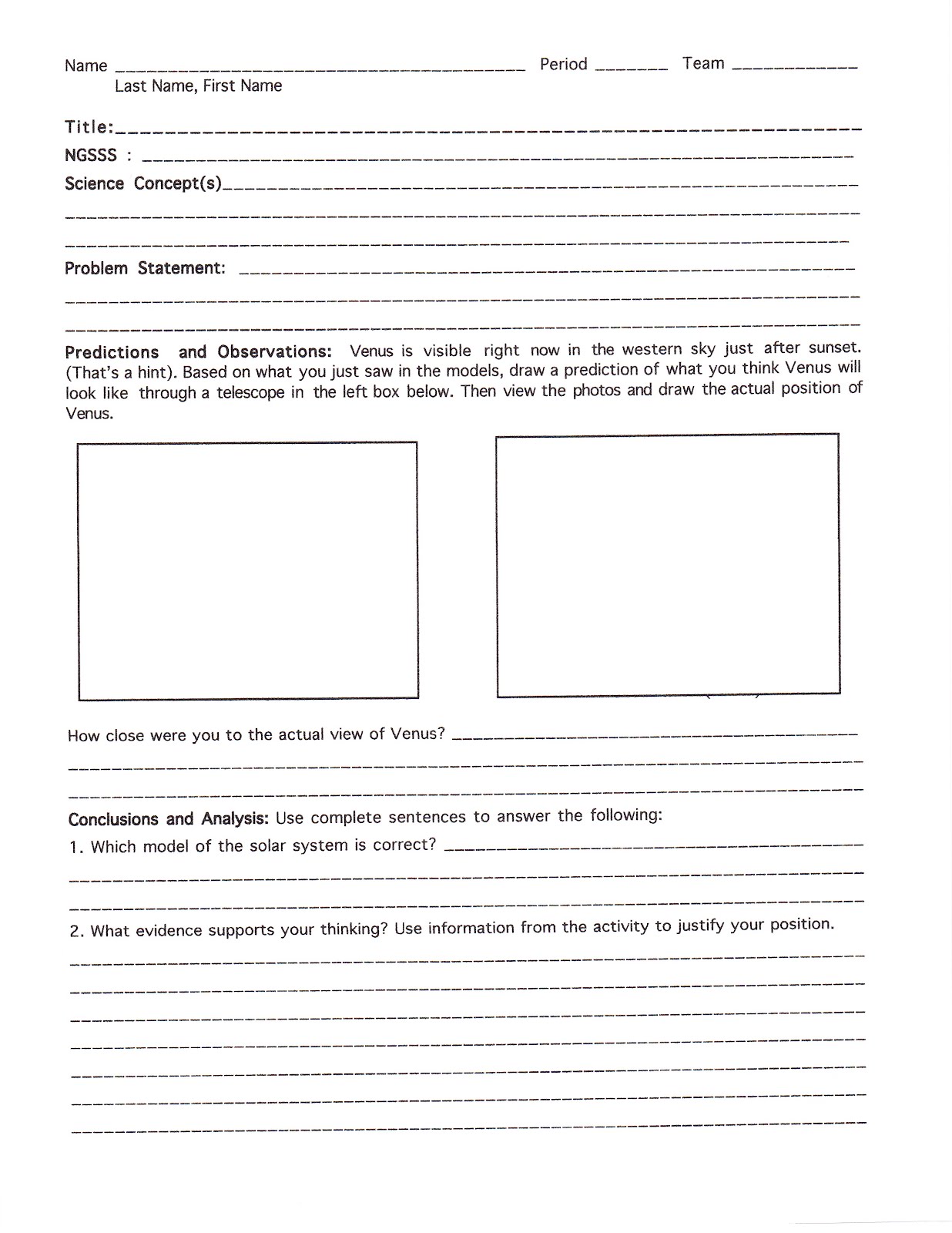
Students today role played to understand the history of how the solar system is constructed. The activity, found at the site
http://www.astrosociety.org/education/astro/bayarea/VirtualVenus.pdf

can be used, along with the handouts found at the top of this blog, to determine if we have a heliocentric or geocentric solar system.

Home learning 11 can also be found at the top of this blog.

Tuesday, February 21, 2012

Tuesday, 21 February, 2012

This is HL 10. Do both on the same sheet of loose leaf paper. Use complete sentences to answer the questions.

Students will be able to:
use the information from internet access, textbooks, and classroom discussions to
-compare and contrast the geocentric and the heliocentric models of the solar system.

Students will work on remediation of sixth grade earth and space benchmarks:

Remediation Week of 2/21/12

SC.6.E.7.1 Differentiate among radiation, conduction, and convection, the three mechanisms by which heat is transferred through Earth’s system.
If you got questions 1 and/or 18 wrong:
1. Do the Pearson assigned activity:
How is heat transferred?
2. Also, go to the Explore Tab and click the link for Chapter 5 and then Chapter 5.1 Heat Transfer. Click the Elaborate tab and complete the Interactive Art activity.
3. Then, go to Dr. Gayden’s Science Zone (drgcdms.podomatic.com) and click the first link to review heat transfer by playing the game.

SC.6.E.7.4 Differentiate and show interactions among the geosphere, hydrosphere, cryosphere, atmosphere, and biosphere.
If you got questions 6, 8, and/or 24 wrong:
1. Do the Pearson assigned activity:
What are the main parts of the earth system?
2. Also, go to the Explore tab and click the link for Chapter 7 and then Chapter 7.1 Interactions among Earth’s Spheres. Click the Elaborate tab and complete the Interactive Art activity.
3. Then, go to Dr. Gayden’s Science Zone (drgcdms.podomatic.com) and review all the information in the second and third links. There are multiple links within the links, so visit each one!

SC.6.E.7.5 Explain how energy provided by the sun influences global patterns of atmospheric movement and the temperature differences between air, water, and land.
If you got questions 15, 29, and/or 32 wrong:
1. Do the Pearson assigned activity:
Greenhouse Effect
2. Also, go to the Explore Tab and click the link for Chapter 7 and then Chapter 7.2 Energy in Earth’s Atmosphere. Click the Elaborate tab and complete the Interactive Art activity.
3. Then, go to Dr. Gayden’s science zone (drgcdms.podomatic.com) and click the fourth link. Read and take notes.

In addition, HL 10 can be found at the top of this blog.

Friday, February 17, 2012

Friday, 17 February, 2012

Students will be able to:
use the information from virtual activities, textbooks, and classroom discussions to
-compare and contrast the characteristics of objects in the solar system.
-compare the characteristics of objects in the Solar System with Earth's characteristics.

Students took the remediation quiz on the sixth grade life science benchmarks. We also reviewed the Solar System lab. Be sure your graph is correct and complete. You can turn the lab in on Tuesday with no penalty.

Students role played the planets, including the dwarf planet Pluto and used to scale pictures to line up showing the distance between these objects and the sun. Students were amazed to see how far Pluto was from everyone!

There was no home learning, but you should update your notebook. In the table of contents, write today's date (2/17), the benchmark (SC.8.E.5.7) and the topic The Solar System. Then, turn to the next available page in your notebook and make a Cornell Notes page. Remember to record this page in your table of contents. On the Cornell notes page, draw something (in color) to remind you of the solar system and the objects in it. On the following page, write notes about chapter four. This should include information on: What makes up the solar system; how did the solar system form; what is the moon like; what do the inner planets have in common; what are the characteristics of the inner planets; what do the outer planets have in common; what re the characteristics of each outer planet; and how do scientists classify small objects in the solar system. Again, this information can be found in pages 137-167 of the 8th grade text.

Thursday, February 16, 2012

Thursday, 16 February, 2012

This is the front of the lab sheet. Be sure to use scientific notation to record the distance from the sun and the diameter.
This is HL 9. Answers only on ONE sheet of correctly headed loose leaf paper.

Students will be able to:
use the information from virtual activities, textbooks, and classroom discussions to
-compare and contrast the characteristics of objects in the solar system.
-compare the characteristics of objects in the Solar System with Earth's characteristics.

Students worked on the lab Solar System, which can be done online. You can find the handouts above, along with tonight's home learning 9. The graph paper is not online. You can get a copy from me or I will upload it tomorrow.

The site you need to complete the chart can be found at:

http://amazing-space.stsci.edu/resources/explorations/trading/game.htm

Wednesday, February 15, 2012

Thursday, 9 February, 2012


This is HL 8. Be sure to do both on the same sheet of loose leaf paper. Answers only. Do them in the correct order.

Students will be able to:
use the information from handouts and classroom discussions to
-explain the process of natural selection.
-explain that natural selection can change the charactaeristics of a population.
-explain how an organism's adaptations help it to survive and the inability to adapt may contribute to the extinction of that species.

Students reviewed crunch time information from the seventh grade by reviewing natural selection. Students read a selection on natural selection in class and answered questions.

Students are reminded that HL 8 is due in class on Thursday. Both handouts (Earth's Moon and Small Solar System Objects) should be answered on only one sheet of loose leaf paper. Answers only. You can find the handouts at the top of this blog.

Monday, February 13, 2012

Monday and Tuesday, 13 and 14 February, 2012

This is HL 7. Read pages 137-141 to answer the questions. All answers on your own paper. Answers only.

Students will be able to:
use the information from virtual activities, textbooks, and classroom discussions to
-compare and contrast the characteristics of objects in the solar system.
-compare the characteristics of objects in the Solar System with Earth's characteristics.

Students worked for two days on their remediation of the sixth grade life science benchmarks. They should visit the Pearson site (myscienceonline.com), use their ID number as user name and password, and complete all the interventions dealing with the cell, the body, classification, and organization of living things.

They should also complete the other exercises listed on the remediation handout:

Remediation Week of 2/13/12

SC.6.L.14.2 Investigate and explain the components of the scientific theory of cells (cell theory); all organisms are composed of cells (single-celled or multi-celllular, all cells come form pre-existing cells, and cells are the basic unit of life.
If you got questions 8, 15, and/or 18 wrong:
Do the Pearson assigned activities:
What is the cell theory?
Then, Google fact monster cell theory and read the passage.

SC.6.L.15.1 Analyze and describe how and why organisms are classified according to shared characteristics with emphasis on the Linnaean system combined with the concept of Domains.
If you got questions 2, 13, 20, 26, and/or 29 wrong:
Do the Pearson assigned activities:
How are organisms classified into Domains and Kingdoms?
What are the levels of classification?
Why do biologists classify organisms?
Then, go to ylearn.co.uk and type in your name access code SC6L151 and complete the activity.
*
SC.6.L.14.4 Compare and contrast the structure and function of major organelles of plant and animal cells, including cell wall, cell membrane, nucleus, cytoplasm, chloroplasts, mitochondria, and vacuoles.
If you got questions 1, 10, 12, and/or 25 wrong:
Do the Pearson assigned activities
How do the parts of a cell work?
What are cells?
Then, go to Dr. Gayden’s science zone (drgcdms.podomatic.com) and click the first link. This will lead to a Discovery Education activity. Type in your first and last name, enter, and click the exploration. Complete the accompanying handout.
*
SC.6.L.14.1 Describe and identify patterns in the hierarchical organization of organisms from atoms to molecules and cells to tissues to organs to organ systems to organisms.
If you got questions 3, 5, 11, and/or 28 wrong:
Do the Pearson assigned activities:
How is your body organized?
What are the levels of organization in an organism?
Then, go to Dr. Gayden’s science zone (drgcdms.podomatic.com) and click the second and third links. Read the pages to learn about the organization of living things. Record the information in your notes
*
SC.6.L.14.5 Identify and investigate the general functions of the major systems of the human body (digestive, respiratory, circulatory, reproductive, excretory, immune, nervous, and musculoskeletal) and describe ways these systems interact with each other to maintain homeostasis.
If you got questions 4, 7, 9 14, 17, 21, and/or 24 wrong:
Do the Pearson assigned activities:
Body systems in action.
How does your body stay in balance?
What is the role of the excretory system?
What systems control body functions?
Then, go to Dr. Gayden’s science zone (drgcdms.podomatic.com) and click the fourth link. This will lead to a Discovery Education activity. Type in your first and last name, enter, and click the The Human Body Game. Follow the directions.

Also:
Complete the GIZMO activity Solar System. This will be placed in your notebook with this week’s notes.

In addition, HL 7 can be found at the top of this blog. It is due in class on Tuesday. Students have the remainder of the home learning pack. HL 8 is due on Thursday, and HL 9 is due on Friday.

Friday, February 10, 2012

Friday, 10 February, 2012

Students will be able to:
use science bowl questions to
-review evolution, natural selection, and heredity.

Students competed in the second Science Bowl. Students in my class competed with those in Ms. Wingate's class on topics such as the Cell Theory, cell structure and function, and Classification.

Those classes not involved with the bowl played Jeopardy by team in the classroom.

There was no nightly home learning assigned.

Thursday, February 9, 2012

Thursday, 9 February, 2012

Students will be able to:
use the information from virtual activites and classroom discussions to
-describe the structure of the sun.
-recognize the features of the sun.

Students took notes today on the features of the sun.

However, before adding these notes to their interactive journal, students updated the journal with the notes from 1/31. The benchmark was SC.8.E.5.4 and the topic was Gravity and Motion. Be sure to add this information to your table of contents. In addition, set up a Cornell notes page with the date and topic. Be sure to draw something to remind you of gravity. Then, on the next page, paste in the three pages of notes via graphic organizers. Next, paste in the three home learnings (1, 2, and 3). Finally, paste in the GIZMO Gravity Pitch. All this should take four pages. Don't forget to write your three leveled questions, use your highlighters to find the answers to the questions in your notes, and to write your summary at the bottom of the Cornell notes page.

For today's lesson, write this information in the table of contents: Date 2/9 Benchmark: SC.8.E.5.5. Topic: The Sun. After skipping the four pages you saved for the notes on Gravity, begin a new Cornell notes page. Draw and label the sun or something that reminds you of the essential questions for the section on the sun (pages 123-127). Also, paste in home learnings 4, 5, and 6 after these notes. Then, place the GIZMO handout on Star Spectra in your notebook. Make sure that you draw a two column notes section on the page directly adjourning the input page for this topic. Make sure you write notes on: The three layers of the sun, the layers of the Sun's atmosphere, and on the features seen on the sun.

There was no nightly home learning.

Wednesday, February 8, 2012

Wednesday, 8 February, 2012

This is HL 6. Answers only on your own correctly headed loose leaf paper.

Students will be able to:
use the information from virtual activites and classroom discussions to
-describe the structure of the sun.
-recognize the features of the sun.
-determine how density relates to mass.

Students watched a BrainPop movie on the Sun.

Students then performed a laboratory exercise entitled Density mystery, where they determined how scientists can learn about the interior structure of the sun. Students used balloon models with and without marbles to simulate how the density of a sun may be different depending on what its core is made of. Students are to turn in the completed lab activity tomorrow.

Students also must turn in HL 6, which can be found at the top of this blog.

Monday, February 6, 2012

Monday and Tuesday, 6 and 7 February, 2012

This is HL 4. Answers only on your own paper. It is due on Tuesday.

This is HL 5. It is due on Wednesday. Complete sentences on your own paper.

Students will be able to:
use the information from virtual activites and classroom discussions to
-describe the structure of the sun.
-recognize the features of the sun.

Students submitted lab 23 and short story three.

Students will use the next two days to work on the GIZMO Star Spectra and to review the secondary benchmarks on classification, the cell theory, energy transformation, and the the sun's energy.

To those ends, students took diagnostic tests from the sixth and seventh grade texts. Areas not at mastery are automatically remediated via the Person online program myscienceonline.com. Use your student ID number as your username and password to access the program.

Students should also complete the following:
SC.6.L.14.2 Investigate and explain the components of the scientific theory of cells (cell theory); all organisms are composed of cells (single-celled or multi-celllular, all cells come form pre-existing cells, and cells are the basic unit of life.

If you go questions 8, 15, and/or 18 wrong:
What is the cell theory?
Then, Google fact monster cell theory and read the passage.

SC.6.L.15.1 Analyze and describe how and why organisms are classified according to shared characteristics with emphasis on the Linnaean system combined with the concept of Domains.

If you got questions 2, 13, 20, 26, and/or 29 wrong:
How are organisms classified into Domains and Kingdoms?
What ore the levels of classification?
Why do biologists classify organisms?
Then, go to ylearn.co.uk and type in your name access code SC6L151 and complete the activity.

SC.7.P.11.2 Investigate and describe the transformation of energy form one form to another.

If you got questions 7, 9, 11, and/or 23 wrong:
Go to www.explorelearning.com and complete the GIZMO Energy Conversions.

SC.7.P.10.1 Illustrate that the sun’s energy arrives as radiation with a wide range of wavelengths, including infrared, visible, and ultraviolet, and that white light is made up of a spectrum of many different colors.

If you got questions 1, 2, 4, 20, 24 and/or 30 wrong:
How do electromagnetic waves compare?
How des the sun’s energy arrive on earth?
What is the electromagnetic spectrum?
Then, go to ylearn.co.uk and type in your name access code SC7P101 and complete the activity.

Home learnings 4 and 5 can be found at the top of this blog. Home learning 4 is due on Tuesday and home learning 5 is due on Wednesday.

Thursday, February 2, 2012

Thursday, 2 February, 2012

Students will be able to:
use the information from hands on activities and classroom discussions to
-undertstand the relationship between mass and gravitational force.
-remediate benchmarks not at sufficient.

Students reviewed how to graph the information and write the conclusions for the lab on mass and gravitational force.

Students then worked on mastering topics for which they needed help. Students individually did readings and hands-on activities from the four reporting categories to boost their knowledge in those areas in which they performed poorly.

Remember, the lab and the short story are due on Monday.

Wednesday, February 1, 2012

Wednesday, 1 February, 2012

These are the directions for short story 3. Be sure to follow them and turn your story in on time!

Students will be able to:
use the information from hands on activities and classroom discussions to
-understand the relationship between mass and gravitational force.

Students received the instructions and rubrics for short story 3. They can be found at the top of this blog. The short story is due in class on Monday.

Today was Digital Day! Students participated with other students around the Nation by using technology in the classroom. Today, students used the Vernier Dual Force probe to investigate the relationship between mass and force. The lab write up is due in class on Monday.

Tuesday, January 31, 2012

Tuesday, 31 January, 2012

This is HL #3. Answers only, on your own paper. Be sure to write only true or only the word that makes the sentence true for questions 1-5.

Students will be able to:
use the information from the textbook and classroom discussions to
-understand what determines gravity.
-describe the role of inertia in keeping objecs in motion.
-determine how gravity helps form objects.

Students took notes from chapter 3, section 3 in their texts (pages 104-109) on the effects of gravity and planets, stars, and solar systems.

Home learning 3 can be found at the top of this blog.

Monday, January 30, 2012

Monday, 30 January, 2012

This is HL #2. Copy the chart and complete. Answer the questions using complete sentences.

Students will be able to:
use the information from virtual activities and classroom discussions to
-observe that gravity causes objects to fall toward the center of Earth.
-Use controlled experiments to discover that gravity becomes stronger as a planet's mass increases and weaker as a planet's radius increases.

Students completed Activities A and C for the GIZMO Gravity Pitch.

Home learning 2 can be found at the top of this blog. Be sure to copy the chart and answer the questions using complete sentences.

Friday, January 27, 2012

Friday, 27 January, 2012

Students will be able to:
use the information from previous studies and classroom discussions to
-review plant and animal cells.
-review the body systems.

Students had a competition between Ms. Wingates's classes for periods 2, and 4-6. Periods 1 and 3 played Jeopardy! in order to review the topics cells and body systems. This will be done every other Friday to prepare for the science FCAT 2.0.

There was no home learning.

Thursday, January 26, 2012

Thursday, 15 January, 2012

Students will be able to:
use the information from individual reading assignments, group discussions, hands-on activites and teacher discussions to
-review the lowest reporting category information from the Winter interim assessment.

Students reviewed questions one through four from the Winter Interim Assessment.

Students then were placed in differentiated instruction groups to review the area on the exam for which they scored the lowest.

Students read passages on the reporting category, and will also complete a hands-on activity associated with that category.

Those low in the Nature of Science read about experimental set ups and will graph data from an experiment to determine conclusions.

Those low in Physical Science read about gravity and air resistance and will measure how friction affects gravity.

Those low in Life Science read about genetics and heredity and will determine how predicting inherited traits occurs.

Those low in Earth and Space Science read about factors that alter the Earth's crust and will determine how sea floor spreading occurs.

There was no home learning assigned.

Wednesday, January 25, 2012

Wednesday, 25 January, 2012

This is HL 1. You received two copies. Complete them both. Keep one copy for yourself. Turn in one copy to me tomorrow.

Students will be able to:
use the information from laboratoary activities and classroom discussions to
-compare and contrast inertia and motion.
-determine the effect of gravity on the motion of an object.

Students watched a BrainPop video on gravity.

Students then did a laboratory experiment to determine what forces act on an object. They spun a ping pong ball, attached to a string, around over their heads and recorded the forces that acted on the ball.

Students also received HL 1, which can be found at the top of this blog.

Tuesday, January 24, 2012

Tuesday , 24 January, 2012

Students will be able to:
use the information from handouts and classroom discussions to
-read a science passage and determine the main idea.

Students read several passages on objects in outerspace, using the reading action plan to find the main idea and answer questions based on the passage.

There was no home learning assigned.

Friday, January 20, 2012

Friday, 20 January, 2012

Students will be able to:
use the information from handouts, group interactions, or texts to
-explain the processes that occur in the circulatory, respiratory, and digestive systems which work together to maintain life in an organism.

Students reviewed the sixth grade benchmark dealing with the human body, specifically, the respiratory system. Students completed a packet after watching a BBC activity. They also answered questions.

There was no home learning assignment.

Thursday, January 19, 2012

Thursday, 19 January, 2012

Students will be able to:
use the information from handouts, group interactions, or texts to
-review and relearn information relating to the four bodies of knowledge.

Students worked in differentiated learning groups to review information such as:
the properties of matter, food webs and chains, the scientific method, and using math in science.

Home learning 18, from page 107 in the text, is to answer questions 1-4 of Do The Math! on properly headed loose leaf paper.

Students also submitted notebooks.

Tuesday, January 17, 2012

Tuesday and Wednesday, 17/18 January, 2012

Students will be able to:
use the information fromthe textbook, articles, and classroom discussions to
-describe how astronomers measure distance.
-describe objects in space.
-distinguish between star systems and galaxies.

Due to testing, classes will meet on a different schedule.

Students watched BrainPop movies on The Life Cycle Of Stars, Galaxies, The Milky Way, and The Solar System.

Students completed the group presentations on the objects in space.

Students read the article What's Out There?

Students in some classes completed the GIZMO on the H-R Diagram.

Students read chapter 3 on astronomical units.

Home learning 17 can be found in the text, page 129 #s 1, 3, 4 and page 131 #s 1, 3. It is due next class meeting.

Notebooks will be collected on Thursday.

Friday, January 13, 2012

Friday, 13 January, 2012

Students will be able to:
use the information from online sites and classroom discussions to
-describe the functions of cell organelles.
-identify organelles of plant and animal cells.
-explain how plant and animal cells differ.

Students interacted with the BBC Cells to Systems activity, found at the site http://www.bbc.co.uk/schools/ks3bitesize/science/organisms_behaviour_health/cells_systems/activity.shtml

Students then read for understanding the handout on cells and systems and answered questions on the topic.

There was no home learning assigned.

Wednesday, January 11, 2012

Wednesday and Thursday, 11 and 12 January, 2012

Students will be able to:
use the information from hands on laboratory experiments and classroom discussions to
-visualize that the universe is expanding.
-calclulate how galaxy positions change as the universe expands.

Students performed a lab that modeled the expansion of the universe and the effect of this expansion on the galaxies in the universe.

Students received HL 16, which is from page 129 in their text. Students are to answer questions 10 and 11 on a sheet of correctly headed loose leaf paper. Be sure to place the name of the stars on your paper.

Students watched a BrainPop movie on the life cycle of stars.

Students also used the reading action plan to read a passage about the objects found in outer space.

Students completed the GIZMO on the H-R diagram.

Monday, January 9, 2012

Monday and Tuesday, 9/10 January, 2012

Students will be able to:
use the information from virtual activities and classroom discussions to
-classify stars based on their color, temperature, luminosity, radius, and mass.
-identify relationships between different star characteristics.
-explain the relationships illustradd by an H-R diagram.

Students began a GIZMO on the H-R Diagram. Since the activity was not completed, it will be completed in class during this week.

Students have home learning 15, which is due in class next class meeting. It should be done on loose leaf paper, properly headed. Students should answer both do the math questions found on page 96. From page 115, they should also write the star types for stars A, B, and C,using the H-R diagram found on page 114.

On Tuesday, as some classes complete the lab, others will use test taking skills to complete a reading passage about objects in outer space.

Thursday, January 5, 2012

Thursday, 5 January and Friday, 6 January, 2012

Students will be able to:
use the information from the textbooks and classroom discussions to
-discover and describe the objects that exist in the universe.

Students were assigned information to present to their classmates on Thursday and Friday about the objects found in space. Each group was assigned a category to research, including planets, stars, comets and other bodies, galaxies, the solar system, and black holes.

On Friday, students took mini-assessment 4 based on photosynthesis and cellular respiration.

Remember, short story 2 is due in class on Friday, along with your laboratory write-up for Measuring Parallax.

Wednesday, January 4, 2012

Wednesday, 4 January, 2012

Students will be able to:
use the information from hands on laboratory activites and classroom discussions to
-construct a model to measure parallax.
-describe how parallax can be used to find the distance between a star and Earth.

Students did a lab that demonstrated how parallax is used to determine the distance between the earth and the nearest stars. The completed lab sheet is due in class tomorrow.

The short story is due on Friday.

Students are also reminded that the winter packet MUST be turned in tomorrow (Thursday) in order to receive extra credit.

Tuesday, January 3, 2012

Tuesday, 3 January, 2012

These are the directions for short story two, which is due in class on Friday.

Students will be able to:
use the information from the textbooks and classroom discussions to
-discover and describe the objects that exist in the universe.

Students who have not submitted their Winter package MUST do so on or before Thursday. In order to receive full credit, BOTH activities must be completed and correct. Extra credit will be given for each assignment in the package. However, if you receive a grade of less than a C, no extra credit will be given.

Students received the directions for Short Story 2, which can be found at the top of this blog.

Students were assigned information to present to their classmates on Thursday about the objects found in space. Each group was assigned a category to research, including planets, stars, comets and other bodies, galaxies, the solar system, and black holes.

Friday, December 16, 2011

Friday, 16 December, 2011

Students will be able to:
use the information from the textbook and classroom discussions to
-review photosynthesis and cellular respiration via a Jeopardy game.

Students played a Jeopardy! game to review the concepts of photosynthesis and cellular respiration.

Home learning is to complete the winter packet.

Have a Merry Christmas!

Thursday, December 15, 2011

Thursday, 15 December, 2011

Students will be able to:
use the information from the textbook and classroom discussions to
-review/remediate sphysical science information.

Students received their Science Winter Packets in homeroom and the information was reviewed. Be sure to write a conclusion page, following the same format as used in lab.

Students then reviewed information on physical science. As a team, students answered questions via the CPS clicker system. The review covered chapters 7-12 of the text.

There is no separate homework. The Winter Packet is due by Thursday, 5 January.

Wednesday, December 14, 2011

Wednesday, 14 December, 2011

Students will be able to:
use the information from the textbook and classroom discussions to
-construct a model to show chemical reactions and conservation of mass.

Students explored the law of conservation of mass and energy by modeling the processes of photosynthesis and cellular respiration. Students used colored blocks to represent atoms of carbon, hydrogen, and oxygen.

Home learning 14 can be found on page 168. Students are to do the Do The Math problems on their own paper.

Tuesday, December 13, 2011

Tuesday, 13 December, 2011

This is HL 13. Answers only on your own correctly headed loose leaf paper.

Students will be able to:
use the information from the textbook and classroom discussions to
-idetermine the processes involved in the water cycle.
-explain how carbon, oxygen, and nitrogen are recycled.
-give examples of how living systems conserve matter and energy.

Students watched BrainPop movies on The Water Cycle, The Carbon Cycle, and The Nitrogen Cycle.

Students also (where necessary) completed the Science Interactives activity on the plant problem. The completed paper is to be placed in the science notebook.

Students reviewed HL 12 and received HL 13, which can be found at the top of this blog.

Students then read and took notes on Cycles of Matter. Be sure to make a Cornell notes page (include in the table of contents; Date 12/13 Benchmark: SC.8.L.18.3; Topic Cycles of Matter). Be sure to write your three Costa's leveled questions, draw or write something to remind you of the lesson (color preferable), and summarize the lesson on the bottom of the page. All notes should be done on the next page. This includes main ideas and supporting details of the information from pages 462-471.

Also be sure to place home learning handouts behind these notes.

Monday, December 12, 2011

Monday, 12 December, 2011

This is HL 12. Answers only on your own correctly headed loose leaf paper.

Students will be able to:
use the information from virtual activities, the textbook and classroom discussions to
-investigate how the levels of dissolved oxygen in pond vary throughout the day.
-learn the source of dissolved oxygen in a pond.

Students did a GIZMO entitled Pond Ecosystem, to determine how the levels of Oxygen change during a day. This ties in with the cycles of nature, including the carbon/oxygen cycle.

The activity is to be placed in the interactive notebook. Be sure that the table of contents includes: Date 12/12 Benchmark SC.8.L.18.3 Topic Pond Ecosystem and the page number.

Turn to a new page in your notebook (be sure to record this page in your table of contents). At the top of the page, write the date and the topic. Make a Cornell notes (six lines from the bottom; column on the left). The left column is to write three questions from the lab activity.
The bottom lines are to record something new you learned while doing this activity. The center box is to draw something that reinforces the lab.

Home learning 12 can be found at the top of this blog. Be sure to answer the questions on your own paper!

Thursday, December 8, 2011

Thursday/Friday, 8/9 December, 2011

Students will be able to:
use the information from virtual activities, the textbook and classroom discussions to
-write a RAFT about cellular respiration or photosynthesis.
-plan and implement a controlled experiment.
-determine the conditions necessary for plant growth.

Due to technical difficulties with internet access and that Thursday was early release:
-all students will receive the same remediation, which uses the virtual lab activities from Science Plus Interactives.
-students will complete the activities on Friday, if they have not been completed on Thursday.

All classes will write a RAFT on cellular respiration. The RAFT is due prior to leaving the class.

Lab papers will all be collected on Friday.

Home learning 11, due on Monday, is answer questions 1-6 on page 475, answers only.

Wednesday, December 7, 2011

Wednesday, 7 December, 2011

Students will be able to:
use the information from hands on activities, the textbook and classroom discussions to
-determine the effect of sugar on the cellular respiration of yeast.

Students completed a lab which helped them understand how yeast react during cellular respiration. Students placed yeast in warm water, with and without sugar to see which would produce carbon dioxide, measured by finding the circumference of a balloon placed over the plastic bottle.

Students are reminded that their data must be compared to that of other groups. The lab is due tomorrow.

Tuesday, December 6, 2011

Tuesday, 6 December, 2011

Students will be able to:
use the information from the textbook and classroom discussions to
-define cellular respiration.
-compare and contrast cellular respiration and photosynthesis.
-describe the process of fermentation.

Students viewed a BrainPop movie on cellular respiration. They then previewed the lab for tomorrow, by completing information on the problem, hypothesis, etc.

Students were not assigned a home learning activity, but should read pages 456-461 to prepare for the lab.

Monday, December 5, 2011

Monday, 5 December, 2011

Students will be able to:
use the information from virtual actities, the textbook and classroom discussions to
-design controlled experiments to test hypotheses.
-discover what gases are used and produced by animals.
-discover what gases are used and produced by plants (in light and dark).

Students worked independently on a GIZMO entitled Plants and Snails. Students proposed a problem, formed a hypothesis, and listed their variables based on the things they observed in the GIZMO. Students then performed their virtual experiment and summarized the experiment in their conclusions. This activity helped them to understand the interdependence of plants and animals and how photosynthesis and cellular respiration are linked.

There was no home learning except to read section 2 of Chapter 13 (pages 451-456) on cellular respiration. Be sure to complete all the activities and questions contained in those pages.

Friday, December 2, 2011

Friday, 2 December, 2011

Students will be able to:
use the information from student presentations, online sites, and classroom discussions to
-present science fair presentations.
-review matter and changes in matter via Jeopardy game.

Students presented their science fair projects to their classmates.

Students then played a game of online Jeopardy, using the theme matter. Students were grouped and answered the questions as a team. This served as a review for matter.

Home learning, to be done on your own paper, is to write, answers only, p 473 questions 1, 2, 6, 7, 8.

Thursday, December 1, 2011

Thursday, 1 December, 2011

Students will be able to:
use the information from computer sites, the textbook and classroom discussions to
-remediate benchmarks which tested not proficient.

Students were grouped for differentiated instruction. Based on the results of the fall interim assessment, students studied one of the following four topics:
-states of matter and mixtures and solutions
-the nature of science/scientific theory and scientific law
-atoms and the periodic table
-properties of matter

There was no home learning assigned, except to update the notebook.

Wednesday, November 30, 2011

Wednesday, 30 November, 2011

Students will be able to:
use the information from laboratory experiments, the textbook and classroom discussions to
-determine how cellular respiration is affected by exercise.

Students reviewed HL 9.

Students then performed a lab to measure the effect of exercise on the production of carbon dioxide. Students measured the time it took to change the color of bromothymol blue from blue to green. This indicator changes color in the presence of carbon dioxide. The more cellular respiration that occurs in the body, the less time it takes to note a color change.

Students should complete the lab write up at home. It is due in class tomorrow.

Tuesday, November 29, 2011

Tuesday, 29 November, 2011

This is HL 9. Answers only on properly headed loose leaf paper.

Students will be able to:
use the information from virtual activities, the textbook and classroom discussions to
-determine how temperature, light intensity, and carbon dioxide levels affect rates of photosynthesis.
-discover what plants need for photosynthesis to occur.

Students presented science fair projects to their classmates.

Students then read and answered the corresponding questions in their text, pages 450-455 about photosynthesis.

Home learning 9 can be found at the top of this blog. Be sure to use properly headed loose leaf paper to record only the answers.

Monday, November 28, 2011

Monday, 28 November, 2011

Students will be able to:
use the information from virtual activities, the textbook and classroom discussions to
-determine how temperature, light intensity, and carbon dioxide levels affect rates of photosynthesis.
-discover what plants need for photosynthesis to occur.

Students completed the GIZMO entitled Photosynthesis. The handouts will be placed in your notebook. Be sure to set up a Cornell Notes page with today's date. The benchmark is SC.8.L.18.1 The topic is Photosynthesis. Be sure to use the space within the box to write or draw something to remind you of the virtual lab experience. Make sure you ask 3 leveled questions that can be answered directly from the handout. Also, in the summary section, be sure to write something you learned from the activity.

There was no home learning assigned.

Wednesday, November 23, 2011

Wednesday, 23 November, 2011

Students will be able to:
use the information from the video Changing Nature and classroom discussions to
-describe how humans interact with the environment and other species.
-determine how food chains and food webs are affected by other species.

Students watched a video, Changing Nature to determine how humankind may affects the environment around them and other living species. Some of the questions that should be answered from the video are:

1. Draw the food chain mentioned in the video.
2. What role does the bunch beetle play in the food chain?
3. What role does the cider poppy play in the food chain?
4. What caused the death of the bunch beetles?
5. How did the dominant species cause a change in the food chain? List the steps.
6. What role did the destruction of the bunch beetle’s habitat play in destroying the food chain?
7. What is the effect of spraying defoliant on all plants? What would ultimately happen to the food web because of this?
8. Earl makes the statement “After all, dinosaurs have been on this Earth for over 150 million years. And it’s not like we’re just going to disappear.” How does this foreshadow what we know happened to the dinosaurs? Could the destruction of the global food web be a probable cause in the extinction of any species?


Remember:

Science Fair Projects Are Due In Class, On the Board, On Monday!!!!!

Tuesday, November 22, 2011

Tuesday, 22 November, 2011

Be sure answers only are placed on a sheet of correctly headed loose leaf paper.

Students will be able to:
use the information from the textbook and classroom discussions to
-explain how living things use the sun's energy.
-describe the process of photosynthesis.

Students reviewed HL 7 and received HL 8, which can be found at the top of this blog.

Students reviewed the requirements for the Science Fair project, which is due in class on Monday, 28 November.

Students took notes on Photosynthesis, pages 451-455.

Monday, November 21, 2011

Monday, 21 November, 2011


Use the reading section to review the functions of the cell organelles. Then choose the correct answer and write only the correct cell analogy next to the numbers on your loose leaf correctly headed paper.

Students will be able to:
use the information from computer sites, the textbook and classroom discussions to
-compare and contrast plant and animal cells.
-review the basic organelles of cells and their functions.

Students completed a GIZMO on Cell Structure. The handout should be completed in placed in the interactive notebook. Be sure to place the Date: 11/21; the Benchmark: SC.8.L.18.1; and the Topic: Plant and Animal Cells in your table of contents. Then, find the next available page and set up a Cornell Notes. Remember to put the date and topic at the top of the page. Use the lab sheet to write three Costa leveled question, to which the answers are already on the handout. Also, use the bottom portion of the page to write something you learned from doing the GIZMO. Finally, draw something to remind you of the lab in the box section.

Home learning 7 can be found at the top of this blog. Be sure to answer on your own paper. You can read the supplemental information to review the functions of the cell organelles. Remember, you are to write the analogy that best describes the organelle.

Friday, November 18, 2011

Friday, 18 November, 2011

Students will be able to:
use the information from computer sites, the textbook and classroom discussions to
-take a mini-assessment on current topics.
-review past topics.

Students took mini-assessment three on information covered during the last three weeks of class.

Students then were grouped to review past topics which were not mastered. If you wish to continue any unfinished work, log on to the Pearson site at:

www.pearsonsuccessnet.com. Use your ID number as both your username and password. Once on the site, click the explore button to review by chapter. You should be able to master ALL the information from chapters: 1-2, and 7-12.

Alternately, you can click the to do button from your home page and complete the assigned tasks. Be sure to click the I'm done button once each task is completed in order to get credit for the assignment.

For those of you were given a word poster to create, please do so at home. All students should continue to work on your Science Fair project.

Thursday, November 17, 2011

Thursday, 17 November, 2011

This is HL 6. BE sure to place answers only on your own sheet of correctly headed loose leaf paper.

Students will be able to:
use the information from computer sites, the textbook and classroom discussions to
-compare and contrast chemical and physical changes.
-determine the properties of a chemical change.

Students reviewed HL 5 and received HL 6, which can be found at the top of this blog.

Students reviewed the lab on the Law of Conservation of Mass. The handout is due in class tomorrow. Be sure to complete the conclusions, using three paragraphs as directed.

Wednesday, November 16, 2011

Wednesday, 16 November, 2011

This is HL 5. Answers only on your won loose leaf paper.

Students will be able to:
use the information from hands-on activities, the textbook and classroom discussions to
-determine that matter is not created or destroyed in a chemical change.
-make a polymer (chemical change) from household ingredients.

Students reviewed HL 4 and received HL 5, which can be found at the top of this blog.

Students completed a lab on measuring the reactants and products of a chemical change. They determined that matter is not gained or lost during a chemical change, but are conserved. Students took the product (Slime) home. Remember, if you wish to keep it in its pristine condition, you need to keep it in the plastic ziplock bag when not in use.

Tuesday, November 15, 2011

Tuesday, 15 November, 2011

This is HL #4. Answers only on a sheet of correctly labeled loose leaf paper.

Students will be able to:
use the information from virtual activities, the textbook and classroom discussions to
-classify changes in matter as chemical or physical.
-identify characteristics o physical and chemical changes.

Students received HL #4, which can be found at the top of this blog. Remember, this sheet should be completed and placed in your notebook. You will submit the answers only on correctly headed loose leaf paper.

Students also received the page for the inside back cover of their notebook. This page should be used to record all user names and passwords for the various websites used in class.

Students watched an Untamed Science video about chemical changes.

Students then took notes on physical and chemical changes, from pages 416-421 in their text.

Monday, November 14, 2011

Monday, 14 November, 2011

Students will be able to:
use the information from virtual activities, the textbook and classroom discussions to
-classify changes in matter as chemical or physical.
-identify characteristics o physical and chemical changes.

Students worked on virtual activities dealing with physical and chemical changes of matter. Students should visit the GIZMO site (www.explorelearning.com) and sign in using your user name and password. Launch the Phase Changes GIZMO and complete the handout. Once you complete the GIZMO, visit Dr. Gayden's Science Zone (drgcdms.podomatic.com) to complete the other portion of the lab. Click the first link under 8th grade students. You will enter a Glencoe virtual lab. Listen to and watch the videos for the events. Be sure to complete the table, writing yes if that property is true or occurred or no if it did not occur. You should be able to answer the conclusion questions after competing the activity.

Continue work on your Science Fair project, which is due on November 28.

Thursday, November 10, 2011

Thursday, 10 November, 2011

Students will be able to:
use the information from the textbook and classroom discussions to
-identify substances as mixtures or pure substances.
-differentiate between the two types of mixtures and their properties.
-describe how mixtures can be separated.

Students took notes on mixtures and their properties. Be sure to make a Venn diagram to compare mixtures and pure substances. Also, make a idea map to describe the methods used to separate mixtures. All notes will come from the text, pages 391-395.

Continue to work on your science fair project, which is due November 28.

Wednesday, November 9, 2011

Wednesday, 9 November, 2011

Students will be able to:
use the information from inquiry activities, the textbook and classroom discussions to
-identify substances as mixtures or pure substances.
-differentiate between the two types of mixtures and their properties.
-describe how mixtures can be separated.

Students used various methods to separate mixtures. They had to separate a sand/iron filings mixture; a salt water mixtures; and a soil and water mixture. Students were to write out their procedures and record their observations as they did each procedure.

The lab sheet is due in class tomorrow.

Monday, November 7, 2011

Monday/Tuesday, 7/8 November, 2011

Students will be able to:
use the information from inquiry activities, the textbook and classroom discussions to
-identify substances as mixtures or pure substances.
-differentiate between the two types of mixtures and their properties.
-describe how mixtures can be separated.
-use observations to explain ways concentrations of a solute can change.

Students performed a virtual lab on mixtures and on solutions.

We did not complete the activity, and will complete it as a whole class tomorrow in class.

Home learning for Tuesday is(HL 3) is:
page 392 1a, b, and c. page 398 copy the first two columns and complete. page 399 a, b, and c, and p 401 1-3

Thursday, November 3, 2011

Thursday/Friday, 3/4 November, 2011

This is HL 2. Answers only on a correctly headed sheet of loose leaf paper.

Students will be able to:
use the information from inquiry activities, the textbook and classroom discussions to
-identify substances as acids or bases.
-differentiate between the properties of acids and bases and their properties.
-describe what happends during a neutralization reaction.

Students read and took notes on acids, bases, and salts from the text, pages 378-381.

Be sure to place the Discovery Ed handout in the notebook after these notes.

Remember, the science fair plan is due on Friday.

Friday's home learning can be found at the top of this blog. Be sure to answer the questions (answers only) on loose leaf paper, correctly headed. The original handout should be completed and placed in your notebook directly after the notes.

Wednesday, November 2, 2011

Wednesday, 2 November, 2011

Students will be able to:
use the information from inquiry activities, the textbook and classroom discussions to
-identify substances as acids or bases.

Students performed an inquiry based lab on acids and bases. They were asked to formulate a question and hypothesis, devise a procedure to test the hypothesis, and gather data. They were then asked to draw conclusions from the experiment. They used distilled water, lime juice, vinegar, ammonia and a baking soda solution in the laboratory. Students also had to list the safety precautions prior to beginning the lab.

Home learning is to complete the lab handout sheet and to work on the science fair package.

Tuesday, November 1, 2011

Tuesday, 1 November, 2011

Students will be able to:
use the information from virtual activities, the textbook and classroom discussions to
-identify substances as acids or bases.
-describe how acids and bases react during a neutralization reaction.
-explain why the proudct of a neutralization reaction is water and a salt.

HL #1 can be found on page 384. Do numbers 10-13 on loose leaf, correctly headed paper.

Students watched a BrainPop movie on Acids and Bases. They then completed a Discovery Education exploration entitled Acids and Bases. You can access the activity by going to Dr. Gayden's Science Zone (drgcdms.podomatic.com) and clicking the second link for today's date. Type in your name to access the link to the activity.

Students should also complete the title, purpose, problem, hypothesis, materials and procedures portions of the science fair plan by Friday, November 4.